How Thermal Pads Improve Battery Heating in Cold Weather
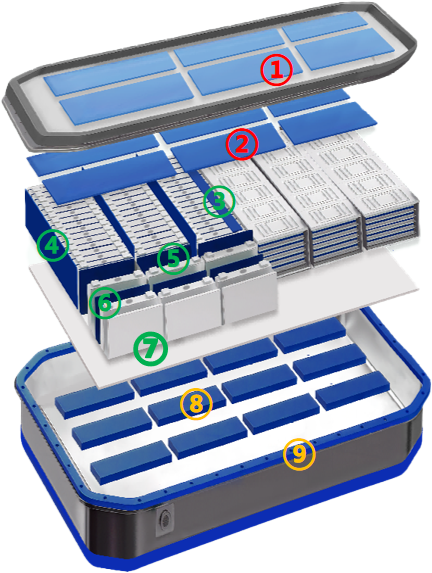
Silicone Thermal Pad Application for Power Battery Heating System
Low-temperature environment is one of the core pain points for new energy power batteries. When the ambient temperature drops below 0℃, lithium-ion battery internal resistance rises sharply, available capacity decays, charging speed drops, and cycle life deteriorates significantly. To solve this problem, most battery PACK designs integrate a heating film or heating wire inside the module, and silicone thermal pad acts as the critical thermal interface material between the heating element and battery cells. Many mechanical and thermal engineers struggle with how to select a qualified battery thermal pad that balances thermal conductivity, compressibility, stability and low outgassing performance.
The basic logic of battery heating is straightforward: the heating source generates heat, and heat needs to transfer evenly to each cell surface without local overheating or cold spots. Air is a poor heat conductor. If there is a gap between the heater and cell, thermal resistance will surge, leading to uneven temperature distribution inside the battery pack. This is exactly where a silicone thermal pad works. It fills microscopic gaps, eliminates air layers, and builds a continuous heat transfer path from heater to cell surface. Unlike thermal grease, phase change material or thermal tape, silicone thermal pad has stable solid form, easy assembly, no pump-out risk after long-term thermal cycling, which makes it widely adopted in automotive power battery heating schemes.
For battery heating scenarios, engineers cannot only focus on thermal conductivity value. Multiple parameters need to be evaluated together: thermal conductivity, hardness, compression rate, thickness tolerance, working temperature range, flame retardancy and chemical compatibility. High thermal conductivity does not always equal the best solution. Ultra-high conductivity grades usually come with higher hardness and higher cost. If the pad is too hard, it cannot conform to the uneven surface of cells and heater, and contact thermal resistance will increase instead. Too soft material may suffer from creep under long-term clamping pressure, which brings hidden risks for long-term PACK reliability.
ITOUSEN SF series silicone thermal pad covers thermal conductivity from 1.5 W/m·K to 15.0 W/m·K, with 12 standard grades for different battery heating power requirements. The hardness is Shore 00 40~60±5, which offers good conformability under low clamping pressure. Available thickness ranges from 0.3 mm to 10.0 mm to compensate different assembly gaps. Continuous operating temperature spans -50℃ to 200℃, fully covering the working window of lithium battery heating and normal discharge. All SF series silicone thermal pad products pass UL94 V-0 flame retardant certification, RoHS, halogen-free and REACH compliance, meeting strict automotive material traceability requirements.
In the actual battery PACK validation test, the matching compression rate is a key index for thermal interface material. For heating side application, the recommended compression ratio of ITOUSEN SF thermal pad is 15%~30%. Within this interval, the material can fully fit the contact surface without excessive permanent deformation. Engineers need to control the gap tolerance carefully during structural design. If the compression is insufficient, gaps remain and heat transfer efficiency drops; over-compression will squeeze the silicone matrix, cause material overflow, and may apply extra stress on cell shell, which is forbidden in battery system design.
Temperature uniformity is the core evaluation target of battery heating function. A qualified battery thermal pad should help the whole module keep temperature difference within 3~5℃ after heating balance. If the thermal interface material has inconsistent density or poor thickness uniformity, hot spots will appear. In cold start test at -20℃ ambient, using well-selected silicone thermal pad can shorten the heating balance time and reduce power consumption of the heating loop. This optimization brings obvious benefits for vehicle winter cruising range and charging experience.
Many engineers confuse cooling application and heating application of thermal interface material. Most public articles focus on thermal pad for heat dissipation, while heating side has different boundary conditions. In cooling path, heat flows from cell to cold plate; in heating path, heat flows from heater to cell. The heat flux direction reverses, but thermal resistance control logic is similar. However, heating side usually works at lower heat flux, so engineers can choose medium conductivity silicone thermal pad to control BOM cost, as long as the thermal resistance target is satisfied. It is unnecessary to blindly specify ultra-high conductivity grades for battery heating only.
Aging test is another necessary verification item for thermal interface material used inside power battery. Thermal cycling test from -40℃ to 125℃, humidity cycling and long-term clamping test will check whether the silicone thermal pad has oil bleeding, hardening, cracking or thermal performance decay. ITOUSEN SF series formula is optimized for low oil bleeding, suitable for closed battery PACK environment. Volatile small molecules may contaminate busbar, insulation film and separator inside battery, so low outgassing performance is a non-negotiable requirement for automotive-grade battery thermal pad.
During prototype stage, engineers are suggested to prepare at least two thermal conductivity grades for comparison test. Record heating curve, temperature difference of each cell, steady-state power consumption and check material status after hundreds of thermal cycles. Do not confirm the material only by datasheet parameters. Actual boundary conditions, surface roughness, clamping structure and assembly process will all change the real thermal resistance of the thermal interface material. Sample testing before mass production is the standard risk control method.
Technical Comparison Table: Silicone Thermal Pad for Battery Heating
| Item | Low Conductivity Grade SF | Medium Conductivity Grade SF | High Conductivity Grade SF | Application Suggestion for Battery Heating |
|---|---|---|---|---|
| Thermal Conductivity | 1.5 ~ 3.0 W/m·K | 4.0 ~ 8.0 W/m·K | 10.0 ~ 15.0 W/m·K | Match heating power & allowed ΔT |
| Hardness | Shore 00 40±5 | Shore 00 50±5 | Shore 00 60±5 | Softer grade preferred for uneven surface |
| Thickness Range | 0.3 ~ 10.0 mm | 0.3 ~ 10.0 mm | 0.3 ~ 10.0 mm | Select by assembly gap |
| Working Temp. | -50 ~ 200 ℃ | -50 ~ 200 ℃ | -50 ~ 200 ℃ | Cover battery heating range |
| Flame Retardant | UL94 V-0 | UL94 V-0 | UL94 V-0 | Mandatory for automotive battery pack |
| Typical Scenario | Low-power heating, small gap | Most passenger car battery heating | High-power heating, strict ΔT requirement | Medium grade is the mainstream choice |
FAQ for Engineers
To sum up, silicone thermal pad is a reliable thermal interface material for power battery heating system. Reasonable selection of battery thermal pad can stabilize cell temperature, reduce cold start energy consumption and improve long-term pack reliability. Engineers should combine thermal simulation, compression structure design and bench test to confirm the final grade. Check ITOUSEN silicone thermal pad SF series datasheet for detailed specifications and sample support.
Silicone Thermal Pads for Network Switches Thermal Interface Material Guide
Related Article