
Thermal Silicone Pad Solutions for Reliable EV Charger Heat Management
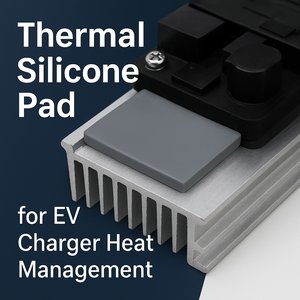
Thermal Silicone Pads in EV Charger Thermal Management: An Engineering Appraisal
As electric vehicle (EV) charger power ratings increase to support faster charging, thermal management of power conversion modules, control electronics, and enclosure structures becomes a decisive factor for safety, efficiency and service life. From an engineering viewpoint, a complete thermal solution spans heat generation, conduction paths, and heat rejection. Among thermal interface options, thermal silicone pads play a pivotal role in bridging hot semiconductor packages and heat-sinking structures while meeting electrical insulation and durability requirements.
1. Thermal context and engineering constraints
High-power DC fast chargers and modular power units concentrate substantial heat in small volumes. The juxtaposition of high heat flux, compact packaging and outdoor deployment places multiple demands on the thermal path: minimized contact thermal resistance, stable mechanical contact under cyclic mechanical/thermal stress, good dielectric withstand, and long-term resistance to environmental aging (UV, humidity, salt spray).
In practice, unavoidable microscopic gaps exist between component cases and cooling plates due to surface roughness and assembly tolerances. These air gaps create disproportionately large thermal resistance because air conductivity is orders of magnitude lower than solids. Engineering the interface to replace air with a compliant, thermally conductive medium is therefore essential.
2. Role and selection criteria for thermal silicone pads
Thermal silicone pads are soft, compressible thermally conductive elastomers designed to enhance contact conductance. Key selection parameters from an engineering perspective include:
- Bulk thermal conductivity (W/m·K) — affects steady-state temperature drop through the pad.
- Thermal contact resistance and behavior under realistic assembly pressures.
- Compression set and elastic recovery — ensures sustained contact over temperature cycles.
- Dielectric strength and volume resistivity — ensures electrical isolation for high-voltage charger applications.
- Environmental stability — resistance to UV, ozone and humidity-induced degradation.
3. Integration challenges in charger designs
From a systems engineering standpoint, thermal silicone pads are not a drop-in fix. They interact with mechanical fastening, enclosure stiffness and manufacturing tolerances. Common integration challenges include:
- Non-uniform compression across multi-module assemblies, leading to uneven thermal paths and localized hotspots.
- Trade-off between thickness and thermal resistance: thicker pads compensate for larger gaps but inherently increase conductive path length.
- High thermal cycling causing gradual compression set; reduced contact area raises interface thermal resistance over time.
- Surface contamination (oil, particulates) that can degrade effective thermal contact in the field.
4. Practical engineering practices
To maximize performance and reliability, engineering teams typically adopt the following practical measures:
- Perform detailed thermal-mechanical simulation (coupled CFD/structural) to predict pad compression distribution and identify hotspots prior to prototyping.
- Specify pad hardness, thickness and pre-load to achieve targeted contact pressures while avoiding over-compression of delicate components.
- Implement controlled surface preparation and clean assembly procedures to maintain consistent thermal contact.
- Conduct accelerated aging and thermal cycling tests (e.g., −40°C to 125°C cycles, compression set tests) to validate lifetime performance under expected field conditions.
5. TOUSEN SF series — engineering fit for EV charger applications
TOUSEN’s SF series thermal silicone pads have been developed as a family of thermally conductive elastomeric pads intended for power electronics applications. From the engineering evaluation standpoint, the SF series addresses several field requirements:
- Consistent thickness tolerance for predictable thermal resistance across assembly runs.
- Optimized compressibility and recovery to maintain interface integrity during thermal cycling.
- Qualified dielectric properties suitable for medium- to high-voltage charger subsystems.
- Environmental robustness against humidity and UV exposure for outdoor enclosure applications.
When applied to DC/DC modules, power stacks and control electronics, the SF series enables repeatable thermal performance while simplifying production assembly compared with liquid potting or hand-applied greases. The removable nature of pad solutions also supports serviceability and module replacement strategies in fielded chargers.
6. Verification and metrics
Engineering verification should quantify both bulk and interface behavior. Recommended metrics and tests include:
- Thermal conductivity measurement (e.g., laser flash or steady-state guarded hot plate) for bulk material.
- Apparent thermal resistance under assembly pressure using a test stack representative of the target module.
- Compression set after representative thermal cycling and static hold periods.
- Dielectric withstand voltage and insulation resistance under elevated temperature and humidity.
7. Future trends and material roadmap
As charger power density increases and wide-bandgap semiconductors (SiC, GaN) proliferate, thermal interface materials must progress in two directions simultaneously: higher effective thermal conductivity and improved long-term mechanical stability under cyclic stress. Hybrid approaches — such as silicone matrices filled with graphite flakes, metal-coated fillers or phase-change elements — can improve heat spreading while retaining compressibility. Engineering teams should evaluate candidate pads in the context of the entire thermal path, not as a standalone component.
8. Conclusion — engineering judgment for durable thermal interfaces
For EV charger thermal systems, thermal silicone pads represent a pragmatic balance of performance, manufacturability and serviceability. When properly specified and validated, pads such as ITOUSEN’s SF series deliver reliable thermal bridging, electrical insulation, and field-replaceable convenience. The key to success lies in system-level validation — coupled thermal-mechanical simulation, targeted test plans, and field-aligned aging tests — rather than reliance on nominal material specifications alone.
High-Performance Thermal Materials for Mining Rigs | TOUSEN
High-Performance Silicone-Free Thermal Pads for Automotive LED Modules | TOUSEN
Related Article