Why Silicone Thermal Pads Beat Grease for Automotive Electronics
Silicone Thermal Pads vs Other Thermal Materials in Automotive Electronics
Automotive electronics have become the most demanding segment for thermal management in modern vehicles. Domain controllers, ADAS cameras, power modules with IGBT and SiC switches, on-board chargers, DC-DC converters and LED lighting each generate heat that must be removed to protect reliability and service life. Unlike consumer devices, automotive electronics must survive wide temperature swings from −40 °C to 125 °C, continuous vibration, and a service life of a decade or more. The thermal interface material selected for these joints is not an accessory; it is a reliability-critical component.
Engineers are regularly asked to choose among several material families: thermal grease, phase change material (PCM), thermally conductive adhesive, thermal tape, graphite sheet and the silicone thermal pad. Each has its place, but for automotive electronics the silicone thermal pad consistently offers the best balance of reliability, ease of assembly and long-term stability. This article reviews, from an engineer’s perspective, why the silicone thermal pad is preferred over other thermal materials in automotive electronics applications, and how to specify it correctly.
The real problems in automotive thermal joints
Automotive assembly is not a laboratory bench. Two mating surfaces are never perfectly flat, and mechanical tolerances stack up from the housing to the printed circuit board. Thermal grease and PCM are applied as thin layers and cannot fill a large gap. If the gap between the heat source and the heat sink exceeds a fraction of a millimetre, a grease layer of practical thickness becomes a high-resistance barrier. A silicone thermal pad, in contrast, is manufactured to a defined thickness and compresses to absorb tolerance, filling gaps from 0.3 mm up to 10.0 mm in the SF series.
Vibration, pump-out and dry-out
Thermal grease is the most common thermal interface material, but it has two weaknesses under automotive vibration. The first is pump-out: under thermal cycling and vibration, the grease migrates out of the joint, leaving a dry interface and rising thermal resistance. The second is dry-out: oils in the grease evaporate over time. Both effects degrade thermal performance progressively over the life of the vehicle. A silicone thermal pad is a solid, self-supporting sheet; it does not pump out, and its cured matrix holds its shape and thermal conductivity over the service life. This is why many automotive OEMs move from grease to thermal pads for long-life applications.
Rework and automated assembly
Modern electronics are built on automated lines, and defective units must be reworked. Thermally conductive adhesives bond components permanently and require cure time, making rework difficult and slow. Thermal tape also fixes the part in place. A silicone thermal pad, often self-adhesive on one side, holds the component in position during assembly yet allows clean removal and reapplication. It requires no cure time, no dispensing equipment and no precise dosage control, which simplifies process qualification and reduces assembly cost.
Electrical insulation and gap filling
In automotive power electronics, the thermal interface material often sits between a live device and the grounded heat sink, so it must be electrically insulating. Graphite sheets are anisotropic and electrically conductive in-plane, requiring an additional insulation layer. Silicone thermal pad material is inherently insulating, so a single component provides both heat transfer and electrical isolation. It also conforms to uneven surfaces under compression, which a rigid graphite sheet cannot do. For irregular die heights or component thicknesses, the compressibility of the pad is a decisive advantage.
Comparison: silicone thermal pad vs other thermal materials
| Property | Silicone Thermal Pad | Grease | PCM | Adhesive | Tape | Graphite |
|---|---|---|---|---|---|---|
| Gap filling (0.3–10 mm) | Excellent | Poor | Poor | Fair | Fair | Poor |
| Pump-out / dry-out risk | None | High | Medium | Low | Low | None |
| Reworkability | Excellent | Fair | Fair | Poor | Poor | Fair |
| Cure / drying time | None | None | Medium | Required | None | None |
| Electrical insulation | Excellent | Varies | Varies | Varies | Varies | No |
| Vibration stability | Excellent | Poor | Fair | Good | Good | Good |
| Automation friendly | Excellent | Fair | Fair | Poor | Good | Good |
Thermal conductivity is not the whole story
A common mistake in material selection is to compare only the nominal thermal conductivity printed on a datasheet. In a real joint, what matters is the total thermal resistance between the device and the heat sink, which combines the bulk resistance of the material with the contact resistance at both surfaces. A grease with high bulk conductivity can still perform poorly if the contact interface degrades under vibration. A silicone thermal pad with a moderate conductivity value often wins in the system because it maintains stable, void-free contact over the lifetime. For automotive electronics, the reliability of the interface matters more than a number on a chart.
This is why the thermal interface material should be evaluated as part of the whole assembly, with the real clamping force and surface finish. The compression ratio of the pad must be controlled: too little compression leaves air gaps, and too much can stress the component. In the SF series, an automotive thermal pad is designed to compress within a practical window, so the engineer can hold a consistent interface through production.
Application examples in automotive electronics
Different automotive modules place different demands on the thermal interface material. In an ADAS domain controller, the main SoC sits between a metal lid and the printed circuit board; an automotive thermal pad of 3 to 5 W/m·K fills the gap and carries the heat to the enclosure. In an on-board charger or DC-DC converter, the power stage with IGBT or SiC switches generates higher heat flux, so a higher-conductivity silicone thermal pad is specified between the module and the cold plate. In LED headlight drivers, the same thermal interface material isolates the electrical circuit while spreading heat to the heat sink. In each case, the silicone thermal pad is chosen by heat flux, gap and lifetime, not by conductivity alone.
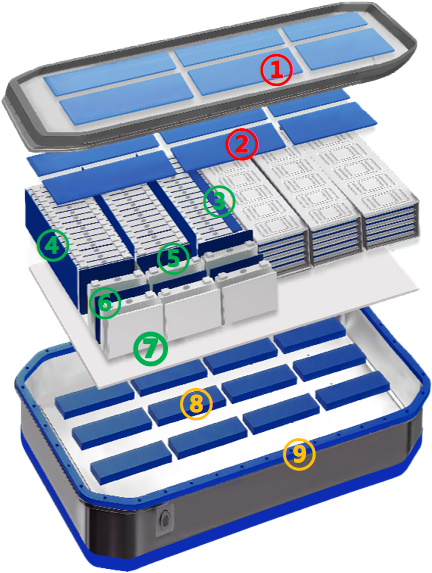
Battery management electronics inside the pack face a similar logic, but with tighter constraints on outgassing and flammability. The thermal interface material used there must not contaminate nearby circuits and must pass the fire safety requirements of the pack. A UL94 V-0 silicone thermal pad meets these constraints, which is another reason the pad is preferred over materials with weaker flammability or higher volatile content.
The SF Series silicone thermal pads for automotive electronics
This is where TOUSEN’s SF Series silicone thermal pads are specified for automotive electronics. The series covers thermal conductivity from 1.5 W/m·K to 15.0 W/m·K across twelve grades, matching the heat flux of different modules from control boards to high-power power electronics. Standard hardness is Shore 00 40/60 ± 5, the operating temperature range is −50 °C to 200 °C, and the material achieves a UL94 V-0 flame rating. Thickness can be customized from 0.3 mm to 10.0 mm, so the pad matches the exact gap of each assembly. Low silicone oil bleed and low siloxane volatility protect sensitive automotive electronics, and the material complies with RoHS, Halogen-Free and REACH.
As an automotive thermal pad, the SF Series is designed to be validated and traceable. Its solid, stable form keeps thermal performance repeatable from part to part, which supports the process control expected in automotive qualification. The series offers representative grades such as SF100 at 1.5 W/m·K, SF500 at 3.0, SF600 at 5.0, SF800 at 8.0 and SF1500 at 15.0 W/m·K, with thermal impedance from 0.90 °C·in²/W down to 0.10 °C·in²/W measured at 1 mm and 30 psi. Full specifications, the complete grade table and die-cut options are available on the SF Series silicone thermal pads product page.
How to select and validate for automotive
Selection of a thermal interface material for automotive electronics should follow the joint’s real boundary conditions: heat flux, gap range, operating temperature, vibration level and target lifetime. Specify the silicone thermal pad thickness from the worst-case tolerance stack, and choose the thermal conductivity from the allowable temperature rise of the component. Then run thermal cycling and vibration tests with the actual clamping structure, and measure thermal resistance at the beginning and end of life. The solid form of the pad makes this validation repeatable and traceable, which is important for automotive qualification flows such as PPAP and APQP.
Do not rely on datasheet values alone. The real thermal resistance depends on surface flatness, clamping pressure and pad compression. A well-selected automotive thermal pad should maintain a stable interface over thousands of thermal cycles without oil bleed or hardness drift. This long-term behaviour is what separates a production-ready thermal interface material from a lab curiosity.
Conclusion
Choosing a thermal interface material for automotive electronics is a reliability decision. The silicone thermal pad offers the combination that grease, PCM, adhesive, tape and graphite each provide only partially: gap filling, electrical insulation, vibration stability, reworkability and automated assembly. For the specifications that support this design, TOUSEN’s SF Series is documented and testable. Engineers are welcome to review the grade table on the product page and to contact our team for thickness and hardness customization based on their specific module design. In the harsh environment of a vehicle, the right automotive thermal pad is not an extra part; it is the part that keeps a junction cool and a warranty intact.
How Thermal Pads Improve Battery Heating in Cold Weather
Related Article