Optical Module Thermal Management Material Selection Guide

How to Choose Thermal Interface Materials for Optical Modules
As optical communication continues to move toward higher transmission speeds, optical modules are facing increasingly demanding thermal management requirements. Higher data rates, increased integration density and continuous operating loads can increase heat generation around lasers, driver ICs, DSPs and other active components. If this heat cannot be transferred efficiently, excessive temperature rise may affect optical performance, component reliability and the service life of the module.
For optical module engineers, selecting the right thermal interface material is therefore not simply a matter of choosing the product with the highest thermal conductivity. Thermal paste, thermal grease and thermal gels each have different characteristics, and their suitability depends on the interface geometry, heat load, assembly process, mechanical tolerance and long-term reliability requirements.
Why Thermal Management Is Critical for Optical Modules
An optical transceiver normally contains several heat-generating components within a relatively compact package. Depending on the architecture, the laser source, optical engine, driver electronics and signal-processing devices may all contribute to the thermal load.
Temperature stability is particularly important for optical components because temperature changes can influence laser characteristics, wavelength stability and overall optical performance. In high-density communication equipment, the accumulated heat from multiple modules can also increase the thermal burden on the system-level cooling structure.
Consequently, the thermal path should be considered from the heat-generating component through the interface material and into the heat sink or chassis. A properly selected thermal paste or thermal grease can fill microscopic surface irregularities and reduce air gaps between mating surfaces, improving heat transfer across the interface.
Thermal Paste or Thermal Grease for Optical Module Cooling
In many engineering applications, thermal paste and thermal grease refer to viscous thermal interface compounds used to improve thermal contact between a heat source and a cooling structure. Their main advantage is the ability to form a relatively thin interface while filling microscopic surface imperfections.
For optical modules with a relatively small and well-controlled interface between a component and heat sink, thermal paste can be a practical solution. However, the final performance depends not only on the intrinsic thermal conductivity of the material.
Engineers should also evaluate:
- Thermal conductivity and effective thermal resistance
- Target bond-line thickness
- Surface roughness and contact quality
- Viscosity and dispensing characteristics
- Wetting and spreading behavior
- Electrical insulation requirements
- Operating temperature and thermal cycling
- Long-term stability and material compatibility
This is particularly important in optical modules because excessive mechanical stress or uncontrolled material movement can be undesirable around precision optical and electronic components.
When Should Engineers Consider Thermal Gels?
Not every optical module has a uniform, thin interface. Component height tolerances, structural differences and larger gaps may make conventional thermal paste or thermal grease less suitable.
In these situations, thermal gels can provide an alternative approach. Thermal gels are generally softer and more conformable than conventional paste-type materials, allowing them to accommodate larger gaps and component-height variations.
For example, when a heat sink must contact several components with different heights, thermal gels may help establish more consistent contact without requiring excessive mechanical compression. Their compliance can also be beneficial where reducing mechanical stress on sensitive components is an important design objective.
However, thermal gels should not automatically be considered superior to thermal paste or thermal grease. The appropriate choice depends on the actual interface structure. A thin and relatively uniform interface may favor paste or grease, while a larger or variable gap may favor a gel-based solution.
Do Not Select Optical Module TIMs by Thermal Conductivity Alone
One of the most common mistakes in thermal material selection is comparing products only according to their advertised thermal conductivity.
In a practical optical module, the total thermal performance is influenced by both the material and the actual interface. A high-conductivity thermal paste may not deliver the expected improvement if it is applied too thickly or if the interface contains voids. Conversely, a material with a moderate conductivity value may provide better real-world performance when it forms a thinner, more uniform and more stable interface.
Therefore, engineers should consider thermal resistance, application thickness and contact conditions together with thermal conductivity.
The objective is not to use the largest possible quantity of thermal grease. Instead, the goal is to establish a controlled and repeatable thermal interface that eliminates unnecessary air gaps while maintaining appropriate mechanical contact.
How to Choose Thermal Materials for Different Optical Module Structures
From an engineering perspective, material selection can be divided into several typical situations.
1. Thin and Uniform Interface
When the heat-generating component and heat sink have a relatively small and consistent interface gap, thermal paste or thermal grease is usually a reasonable starting point. These materials can conform to microscopic surface irregularities while maintaining a relatively thin interface.
2. Larger or Variable Interface Gap
If the optical module contains significant height variation or a larger thermal gap, thermal gels may be more appropriate. Their compliant characteristics can help maintain contact across different component heights.
3. High-Volume Automated Manufacturing
For mass production, the application process becomes an important selection criterion. A thermal paste should not only provide suitable thermal performance but also demonstrate stable dispensing, printing or coating behavior.
Process repeatability is particularly important because variations in application quantity can lead to variations in bond-line thickness and therefore differences in thermal resistance between production units.
TOUSEN TSAS50 for Optical Module Thermal Management
For optical and communication electronics requiring a paste-type thermal interface, TOUSEN TSAS50 can be considered as part of the material evaluation process.
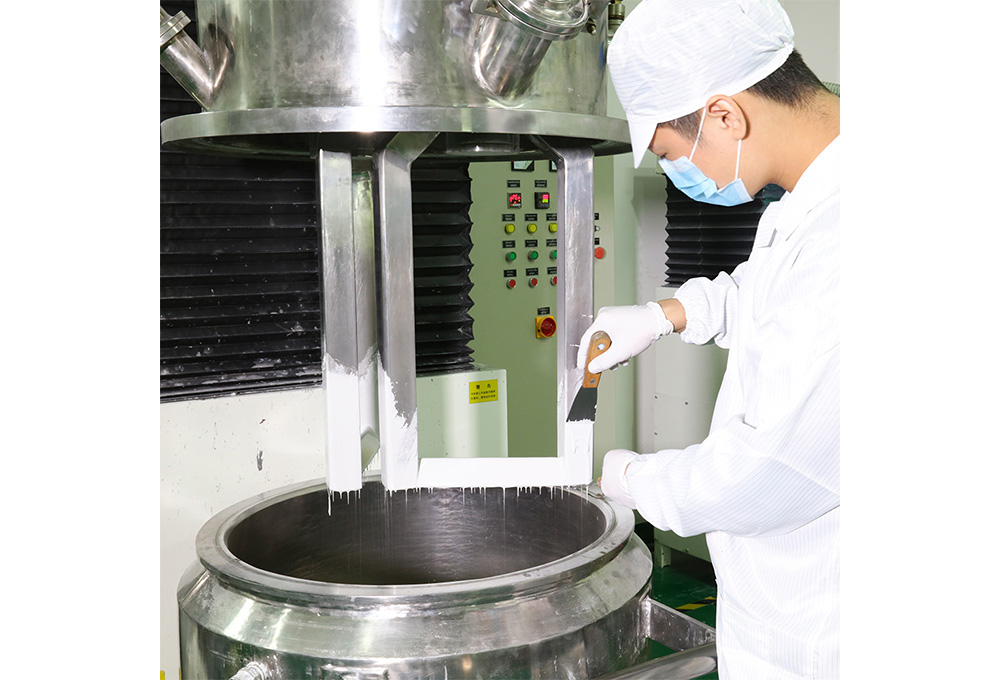
TSAS50 is a one-component, non-curing thermally conductive compound based on a silicone matrix and thermally conductive fillers. According to the available product specifications, TSAS50 provides a thermal conductivity of 7.0 W/m·K and a thermal resistance coefficient of 0.025 °C·cm²/W at 60 psi. Its specified viscosity is 120 Pa·s at 22°C, while volume resistivity is specified at 1.7 × 10¹² Ω. The material is also described as solvent-free and suitable for screen-printing processes.
These characteristics make TSAS50 worth evaluating for optical communication assemblies where engineers need a controlled paste-type thermal interface and repeatable manufacturing process. The material can be considered for interfaces between heat-generating electronic components and heat dissipation structures, subject to validation under the actual optical module design.
For detailed technical information, engineers can refer to the TOUSEN TSAS50 Thermal Paste product page.
Engineering Validation Before Mass Production
Regardless of whether the selected material is thermal paste, thermal grease or thermal gels, application-specific testing remains essential.
For optical modules, engineers should ideally evaluate the material under representative operating conditions. Testing can include temperature-rise measurements, thermal resistance evaluation, thermal cycling, aging, mechanical stability and compatibility with adjacent materials.
The actual dispensing volume and bond-line thickness should also be controlled during testing. A material that performs well in a laboratory test may produce different results in production if the application process is not sufficiently controlled.
For high-speed optical communication systems, thermal validation should also be correlated with the optical performance of the module. This system-level approach can provide more meaningful information than evaluating the TIM independently.
Conclusion
The selection of thermal materials for optical modules should be treated as a system-level engineering decision. Thermal paste, thermal grease and thermal gels each have appropriate application scenarios, and none should be selected solely according to a single thermal conductivity value.
For thin and relatively uniform interfaces, thermal paste or thermal grease can provide an efficient thermal path with controlled bond-line thickness. For larger gaps or significant component-height variations, thermal gels may offer better mechanical conformity.
For applications where a paste-type interface is required, TOUSEN TSAS50 provides engineers with an option to evaluate in optical communication and other electronic thermal management applications. Its thermal conductivity, thermal resistance, viscosity, electrical properties and processing characteristics should be considered together with the actual module structure.
Ultimately, the best thermal interface material is not necessarily the material with the highest advertised thermal conductivity. It is the material that can provide predictable thermal performance, appropriate mechanical behavior, manufacturing consistency and long-term reliability under the real operating conditions of the optical module.
Thermal Management for Optical Modules in the AI Token Era
Thermal Management for Optical Modules in AI Data Centers
Related Article