High-Performance Silicone-Free Thermal Pads for Automotive LED Modules | TOUSEN
Thermal Silicone Pads in Automotive LED Headlights
In modern automotive design, LED headlights have become the dominant light source due to their high luminous efficiency, compact form factor, and long lifespan. However, these advantages come with unprecedented thermal management challenges. LED chips generate concentrated heat flux during operation, and without effective thermal management, this can lead to reduced luminous output, color shift, shortened module lifespan, and potential safety risks. As a result, thermal interface materials (TIMs) are essential for maintaining optimal thermal performance in automotive headlight systems.
1. Current State of Thermal Management in Automotive Headlights
Within LED headlight modules, heat sources are primarily concentrated in the LED chips and driver circuits. Traditional metal heat sinks combined with natural convection are often insufficient for compact, high-density LED arrangements, making interface thermal resistance the primary bottleneck. Micro-to-millimeter gaps between the LED package and heat sink require TIMs to maintain high heat transfer efficiency. Without proper interface materials, localized hotspots can cause LED degradation or inconsistent optical performance.
Thermal silicone pads are widely used in this context due to their unique combination of properties:
- Flexibility and compressibility to fill uneven gaps between LED packages and heat sinks;
- Electrical insulation to prevent short circuits between high-brightness LEDs and metal components;
- Compatibility with die-cutting and automated assembly processes, ensuring consistent mass production.
2. Technical Challenges in Automotive LED Applications
Despite widespread adoption, engineers face several technical challenges when integrating thermal silicone pads into automotive headlights:
- Interface Thermal Resistance and Transient Heat Dissipation: Even with ceramic or graphite fillers, silicone pads have limited intrinsic thermal conductivity. In high-power LED modules, hotspots may persist, leading to reduced light output or color shifts. Interface thermal resistance (Rθ) can be calculated as:
Rθ = (TLED - THeat Sink) / P, where T is temperature in °C and P is power in watts. - Thickness, Hardness, and Compression Balance: Soft pads conform well to surface irregularities but increase thermal resistance, whereas harder pads lower thermal resistance but require higher compression forces, risking uneven contact and reduced long-term reliability.
- Long-Term Reliability: Automotive LED modules must endure thermal cycling, humidity, and vibration. Pads must resist compression set, pump-out, cracking, and maintain low outgassing over the vehicle's lifespan to ensure stable thermal performance.
- Optical Contamination: Volatile substances or migration from pads can deposit on lenses or reflectors, reducing optical efficiency. Silicone-free or low-outgassing formulations are increasingly preferred to mitigate this risk.
3. TOUSEN Engineering Experience and AF Series Solutions
TOUSEN, as a leading supplier of thermal interface materials in China, has over a decade of experience in automotive LED headlight applications. The AF Series (silicone-free) is optimized for 3–5 W LED modules and demonstrates the following advantages:
- Silicone-Free Formulation: Minimizes optical contamination risks for sensitive lens and reflector surfaces;
- Optimized Thermal Conductivity: Carefully engineered filler composition ensures a balance between thermal performance and flexibility, reducing interface thermal resistance while maintaining conformability;
- High Conformability and Die-Cut Compatibility: Supports complex shapes, automated assembly, and ensures consistent pressure distribution across the interface;
- Automotive-Grade Reliability: Passes rigorous thermal cycling, humidity, and vibration tests to guarantee long-term stability.
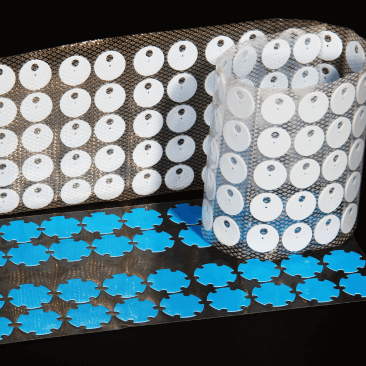
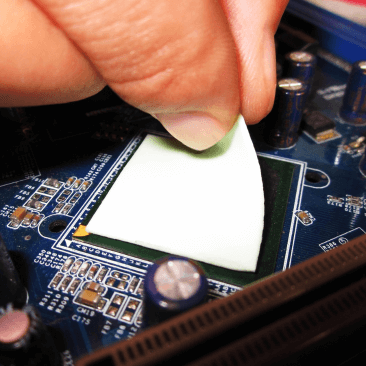

TOUSEN engineers evaluate LED power, heat sink design, module thickness, and assembly pressure to select the optimal pad thickness and hardness. The goal is to minimize interface thermal resistance while ensuring conformability, reliability, and optical safety.
4. Reliability Verification and Testing Recommendations
For engineering validation, a comprehensive testing plan is recommended:
- Initial Thermal Performance: Measure steady-state LED temperature and heat sink temperature under normal operating power, and calculate Rθ to confirm material effectiveness.
- Thermal Cycling: Subject pads to -40°C to +125/150°C cycles for 1000–1500 iterations to evaluate interface thermal resistance changes and detect potential cracking or pump-out.
- Humidity and Damp Heat: Test at 85°C/85% RH for 500–1000 hours to assess material stability and monitor optical contamination risk.
- Vibration and Shock: Perform ISO 16750-3 or SAE J1378 standard tests to ensure the pad remains in position without degradation under automotive vibration and shock conditions.
- Electrical Insulation: Verify volume resistivity and dielectric strength to ensure the pad maintains electrical isolation throughout the module lifespan.
5. Industry Trends and Engineering Recommendations
- High-power LED modules demand lower interface thermal resistance and enhanced transient heat dissipation performance;
- Silicone-free, low-outgassing formulations are increasingly important for optical-sensitive applications;
- Flexible, die-cut compatible pads remain the primary choice for automated, high-volume production.
Engineers are advised to focus on interface thermal resistance, thermal cycling reliability, optical compatibility, and mechanical fit during material selection. For high-density hotspot applications, system-level combinations with graphite sheets, phase-change thin films, or vapor chambers can further enhance heat dissipation.
Conclusion
In automotive LED headlights, thermal silicone pads play a crucial role beyond simple gap filling. They ensure optical performance, thermal efficiency, and long-term reliability. TOUSEN's AF Series silicone-free thermal pads provide engineers with high-performance, reliable, and mass-production-ready solutions, meeting the demanding requirements of modern automotive LED systems in terms of efficiency, stability, and optical safety. By leveraging extensive engineering experience and optimized materials, TOUSEN supports the development of safer, brighter, and longer-lasting LED headlight modules.
Thermal Silicone Pad Solutions for Reliable EV Charger Heat Management
Thermal Interface Materials for Security Devices|TOUSEN
Related Article