
Thermal Heating Pad Guide: Best Thermal Pads for GPU Cooling
An Engineering Perspective on Thermal Interface Materials: Practical Guidelines for Selecting Thermal Heating Pads
In modern electronic systems, rising power density and increasing integration levels have made thermal management a critical factor in determining long-term reliability and performance. From an engineering standpoint, the choice of thermal interface materials (TIMs) is no longer a secondary consideration but a core design decision that directly affects junction temperature, component lifespan, and system stability.
Among various TIM solutions, the thermal heating pad has become widely adopted in industrial electronics, telecommunications equipment, power modules, and graphics processing units (GPUs) due to its mechanical stability, consistent thickness control, and predictable long-term behavior. This article provides an objective and technical overview of how to evaluate thermal pads, what defines the best thermal pads, and why thermal pads GPU applications require special attention.
Why Thermal Interface Materials Are Critical in Heat Transfer
Heat transfer efficiency is often limited not by the heat sink itself, but by microscopic air gaps between mating surfaces. Even precision-machined metal surfaces contain surface roughness that traps air, which has extremely low thermal conductivity. TIMs are designed to replace air pockets with higher-conductivity materials, reducing contact thermal resistance and enabling efficient heat flow from heat sources to cooling structures.
Traditional solutions such as thermal grease offer low initial thermal resistance but may suffer from pump-out, dry-out, and contamination over time. In contrast, a properly selected thermal heating pad provides stable mechanical contact, controlled thickness, and consistent performance across extended operating cycles.
What Is a Thermal Heating Pad?
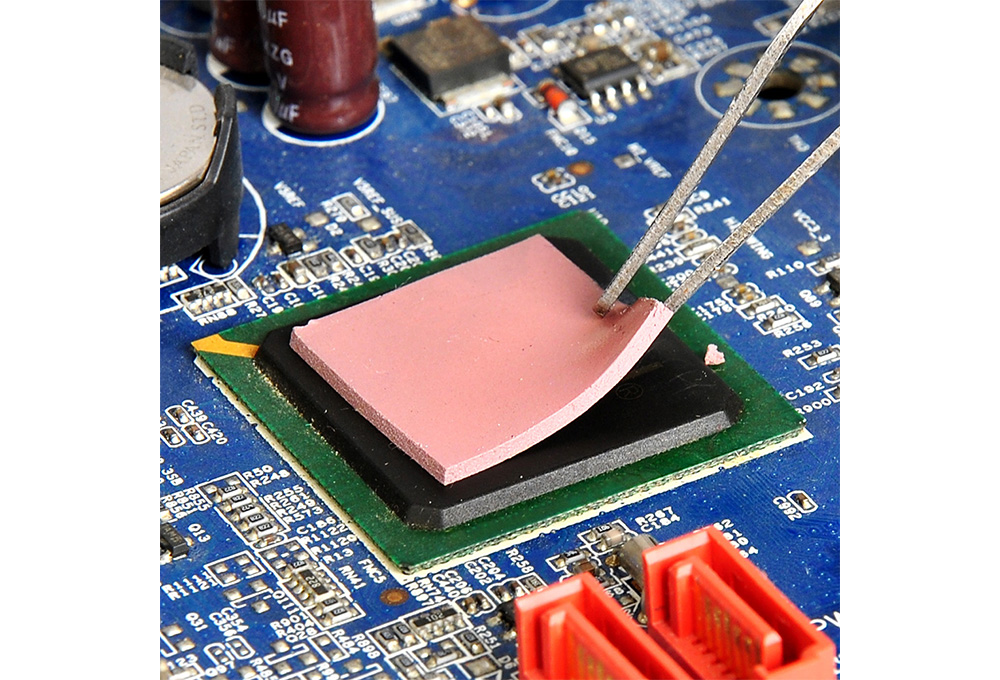
A thermal heating pad is a solid or semi-solid thermal interface material typically composed of thermally conductive fillers—such as boron nitride, aluminum oxide, or ceramic particles—dispersed within an elastic polymer matrix, commonly silicone-based. This structure allows the pad to compress under mounting pressure, conform to surface irregularities, and maintain reliable thermal pathways.
Compared with liquid or paste-based TIMs, thermal pads offer several engineering advantages:
- Non-migrating and non-bleeding behavior
- Stable thickness for controlled thermal resistance
- Ease of assembly in automated production lines
- High repeatability in mass production environments
These properties explain why the thermal heating pad has become a preferred solution in high-volume manufacturing and mission-critical electronics.
Key Engineering Metrics That Define the Best Thermal Pads
Selecting the best thermal pads requires more than reviewing datasheet values. Engineers must consider a combination of thermal, mechanical, and reliability-related parameters:
1. Thermal Conductivity
Thermal conductivity (W/m·K) indicates how effectively heat flows through the material. Higher values reduce thermal resistance and improve overall cooling efficiency. For high-power devices, materials above 5 W/m·K are generally recommended, while advanced systems may require 8–12 W/m·K or higher.
2. Thermal Resistance
Actual interface thermal resistance depends on both conductivity and pad thickness. Thicker pads increase resistance but may be necessary to bridge mechanical gaps. Engineering optimization often involves balancing minimal thickness with sufficient compression compliance.
3. Mechanical Compliance
Good compression characteristics ensure uniform contact pressure and gap filling. Pads with poor elasticity may fail to fully conform to surface irregularities, leading to localized hot spots.
4. Long-Term Stability
High-quality best thermal pads must maintain thermal and mechanical properties under prolonged thermal cycling, humidity exposure, and mechanical vibration without cracking, hardening, or material migration.
5. Electrical Insulation
Many electronic assemblies require electrical isolation between heat sources and heat sinks. Most modern thermal pads are electrically insulating, but verification remains necessary in safety-critical applications.
Special Considerations for Thermal Pads in GPU Applications
GPU thermal environments present unique challenges. Modern GPUs operate at high thermal flux densities, and thermal loads fluctuate rapidly depending on computational workloads. As a result, thermal pads GPU solutions must meet stricter performance requirements than standard electronics.
High Heat Flux Capability
GPUs generate concentrated heat over relatively small contact areas. In such cases, thermal pads must sustain high heat transfer rates without degradation or thermal bottleneck formation.
Multi-Component Cooling Requirements
Graphics cards typically contain multiple heat sources, including memory modules and power regulation components. Thermal pads GPU designs must support different thickness options to accommodate varying gap distances across the PCB while maintaining consistent thermal contact.
Thermal Cycling Durability
Frequent power on/off cycles subject materials to repeated thermal expansion and contraction. High-quality thermal pads must resist fatigue and preserve mechanical integrity under such dynamic conditions.
Engineering Validation and Selection Process
In professional thermal design workflows, material selection follows a structured validation process rather than purely datasheet comparison:
- Definition of thermal targets and mechanical constraints
- Preliminary simulation and material screening
- Prototype-level thermal testing under realistic loads
- Environmental reliability testing (thermal cycling, humidity, vibration)
- Manufacturing compatibility and assembly verification
This systematic approach ensures that the chosen thermal heating pad delivers predictable performance throughout the full product lifecycle.
Recommended Engineering-Grade Thermal Pad Solution
Based on extensive laboratory testing and real-world deployment across industrial electronics and high-power GPU cooling platforms, the TOUSEN TIM Thermal Pad series offers a balanced combination of thermal efficiency, mechanical reliability, and long-term stability.
Product details and technical specifications are available at:
https://www.itousen.com/TOUSEN-TIM-THERMAL-PAD.HTML

Key engineering advantages include:
- High thermal conductivity options for demanding heat loads
- Excellent compressibility for complex mechanical assemblies
- Stable performance under extended thermal cycling
- Multiple thickness configurations for design flexibility
- Electrical insulation suitable for sensitive electronic systems
These characteristics make the product well suited for applications where consistent thermal performance and system reliability are non-negotiable.
Conclusion
From an engineering perspective, selecting the appropriate thermal heating pad is a data-driven decision that directly influences system thermal margins and product longevity. While many products on the market advertise high conductivity, only the best thermal pads demonstrate balanced performance across thermal, mechanical, and environmental dimensions.
In GPU and other high-power electronics, properly engineered thermal pads GPU solutions play a vital role in preventing thermal throttling, reducing component stress, and maintaining long-term operational stability. Through objective testing and careful validation, engineers can ensure that thermal interface materials support—not limit—the performance of advanced electronic systems.
Thermal Heat Pad Guide Best GPU Thermal Pads Selection
Engineering Guide to Gold Thermal Tape for Electrical Systems
Related Article