Why Regular Thermal Paste Replacement Matters for Thermal Management
Why Regular Thermal Paste Replacement Matters in Thermal Management
In modern electronic equipment, thermal management is no longer a secondary design consideration. CPUs, GPUs, power supplies, LED modules, ECUs, gaming systems and other high-power electronic assemblies continuously generate heat during operation. If this heat cannot be transferred efficiently from the heat-generating component to the heatsink or chassis, operating temperature can gradually increase, resulting in reduced performance, thermal throttling, accelerated material aging and, in severe cases, reliability problems.
From an engineering perspective, the thermal interface material between a heat source and a heat sink is one of the critical factors determining the efficiency of heat transfer. Among different thermal interface materials, thermal paste remains widely used because it can fill microscopic surface irregularities and reduce the air gaps that would otherwise create significant thermal resistance.
Why Thermal Paste Degrades Over Time
A new layer of thermal paste is designed to create a continuous thermal interface between two mating surfaces. Even when a CPU, GPU or power device appears to have a flat surface, microscopic machining marks, surface roughness and assembly tolerances create small air gaps. Because air has relatively poor thermal conductivity, these gaps can significantly increase interface thermal resistance.
Thermal paste fills these microscopic voids and creates a more efficient heat-transfer path. However, the material does not necessarily remain in its original condition throughout the entire service life of equipment.
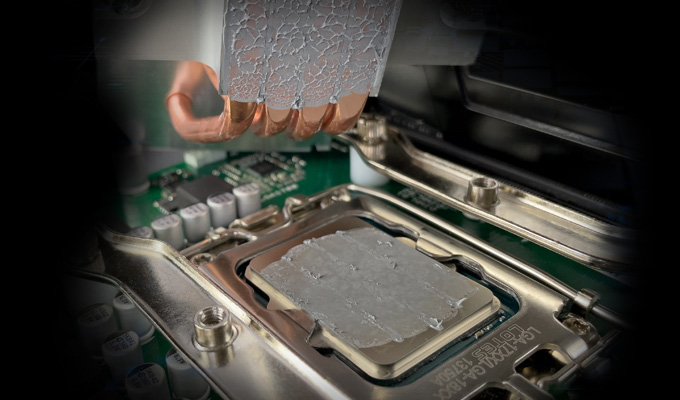
Repeated heating and cooling cycles can cause physical changes within the thermal interface. Depending on the formulation, application thickness, assembly pressure and operating environment, the material may experience migration, oil separation, evaporation, drying or changes in viscosity. Mechanical vibration and differences in thermal expansion between the component, PCB and heatsink can also influence long-term interface stability.
This is why replacing thermal paste should be considered as part of preventive maintenance for equipment operating under demanding thermal conditions rather than simply as a repair measure after overheating occurs.
Thermal Paste vs Thermal Grease: What Is the Difference?
In the thermal management industry, the terms thermal paste and thermal grease are frequently used interchangeably. In many applications, both refer to non-curing thermally conductive compounds designed to reduce thermal contact resistance between a heat-generating component and a heat sink.
However, engineers should not select a material based only on terminology. The actual formulation and technical specifications are much more important. Thermal conductivity, thermal resistance, viscosity, dielectric properties, pump-out resistance, oil separation, evaporation loss, operating temperature and long-term stability should all be evaluated according to the application.
For high-performance electronics, a material with high nominal thermal conductivity does not automatically guarantee better system-level thermal performance. The actual bond line thickness, contact pressure, surface condition and long-term stability of the interface can be equally important.
Why Regular Replacement Should Be Part of Thermal Maintenance
For equipment subjected to continuous operation, periodic inspection of the thermal interface can help engineers identify degradation before it becomes a major reliability problem. There is no universal replacement interval because actual service life depends on operating temperature, duty cycle, material formulation, mechanical construction and environmental conditions.
For example, a workstation used occasionally under moderate loads may require less frequent maintenance than a server, industrial controller or gaming computer operating at high load for extended periods.
Engineers should therefore monitor several indicators rather than rely exclusively on a fixed replacement schedule:
- Unexpected increases in CPU, GPU or component operating temperature
- Increasing fan speed or cooling system noise
- Thermal throttling under sustained loads
- Repeated temperature fluctuations during load changes
- Visible drying, cracking or migration of the interface material
- Long-term changes in system thermal performance
When these symptoms appear, inspection and replacement of the thermal paste can be a relatively simple maintenance step compared with replacing an overheated electronic component.
How Thermal Grease Performance Should Be Evaluated
When selecting a thermal grease, engineers should look beyond the thermal conductivity number printed on a datasheet. Thermal conductivity is normally expressed in W/m·K, but the thermal performance of an assembled interface is also affected by thermal resistance and bond line thickness.
Viscosity is another important consideration. A material that is too fluid may migrate during operation, while a material that is excessively viscous may be difficult to dispense or may produce inconsistent coverage. Thixotropic behavior can provide a useful balance by allowing easier application while helping the material remain in position after dispensing.
Electrical insulation can also be important in applications where the thermal interface is located near exposed electronic circuits. Engineers should evaluate volume resistivity and other electrical characteristics according to the system's safety requirements.
TSAS50 Thermal Grease for High-Performance Electronics
For applications requiring a stable, non-curing thermal interface, TOUSEN's TSAS50 Thermal Grease provides an example of how thermal performance and process characteristics can be considered together.
TSAS50 is a gray, one-part, non-curing thermally conductive compound based on a silicone matrix with thermally conductive fillers. According to the product specifications, it provides a thermal conductivity of 7.0 W/m·K and a thermal resistance coefficient of 0.025 ℃·cm²/W at 60 psi. Its viscosity is specified at 120 Pa·s at 22℃, with a volume resistivity of 1.7 × 10¹² Ω.
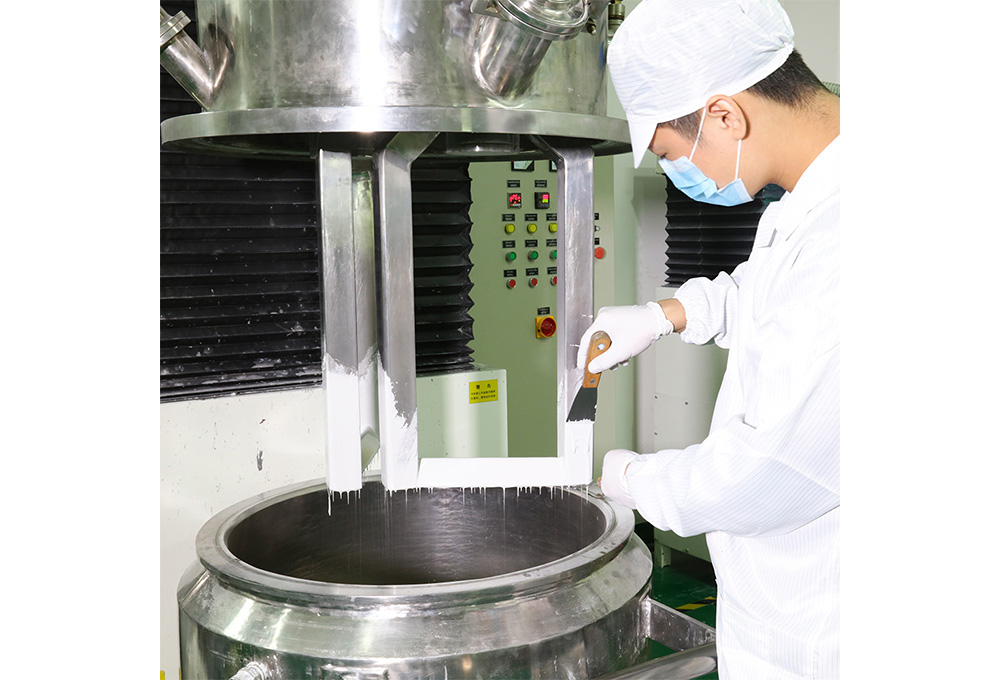
The formulation is also designed to provide low slump, low thermal resistance and a thin bond line. TSAS50 is solvent-free, requires no curing process and can be screen printed, which can be useful for manufacturers looking for a repeatable thermal interface process in production environments.
For reference, the manufacturer specifies an oil separation rate below 0.01% after 96 hours at 200℃ and a liquid evaporation loss of 0.13% after 96 hours at 120℃. These parameters can be useful when engineers evaluate the long-term stability of a thermal interface under elevated-temperature conditions.
TSAS50 is designed for applications including CPUs, GPUs, power supply units, LED modules, engine control units, gaming consoles and laptops.
Learn more about TSAS50 Thermal Grease
Thermal Gels Are Not a Universal Replacement for Thermal Paste
Another category frequently considered during thermal interface material selection is thermal gels. Thermal gels can provide advantages in applications requiring soft, compliant interfaces, particularly where there are larger or variable gaps between components and heat spreaders.
However, thermal gels and conventional thermal paste are not automatically interchangeable. Their mechanical properties, dispensing behavior, compression characteristics and long-term reliability can be substantially different.
For a very small interface gap between a CPU or GPU and a heatsink, a suitable thermal paste or thermal grease may provide an efficient solution. For larger gaps or applications requiring greater compliance, thermal gels may be more appropriate. The correct choice should therefore be based on actual mechanical structure and thermal requirements rather than simply selecting the material with the highest advertised thermal conductivity.
How to Establish a Practical Replacement Strategy
For engineers responsible for equipment maintenance, the most practical approach is to combine scheduled inspection with actual thermal performance data. Before replacing the interface material, record the component temperature under a defined workload. After cleaning and applying new material, repeat the same test conditions. This provides a more objective basis for determining whether the interface has degraded.
During replacement, surface cleaning is equally important. Old material should be completely removed without damaging the component or heatsink. The new thermal paste should then be applied according to the manufacturer's recommended process. Excessive application does not necessarily improve thermal performance; the objective is to create a uniform interface with an appropriate bond line.
For production equipment, engineers should also consider dispensing consistency, assembly pressure, surface flatness and process repeatability. A technically excellent thermal grease can still deliver inconsistent results if the application process is poorly controlled.
Conclusion
From an engineering perspective, thermal interface materials should be treated as functional components of a thermal management system rather than simple consumables. Regular inspection and appropriate replacement of thermal paste can help maintain heat-transfer efficiency, particularly in electronics operating under continuous or high-load conditions.
At the same time, material selection should consider the complete application. Thermal grease may be suitable for low-gap interfaces requiring efficient surface contact, while thermal gels can be advantageous where compliance and gap filling are more important. There is no single thermal interface material that is optimal for every application.
For demanding electronics, the correct engineering approach is to evaluate thermal conductivity, thermal resistance, viscosity, electrical insulation, long-term stability, application process and actual operating conditions together. Products such as TOUSEN TSAS50 demonstrate how a properly engineered thermal interface compound can combine high thermal conductivity, low thermal resistance and process stability to support reliable electronic thermal management.
Learn how thermal paste improves CPU heat transfer, reduces interface thermal resistance, and supports reliable cooling performance in high power computing systems.
Thermal Paste Thermal Conductivity and Thermal Management
Related Article