Thermal Paste Testing: Dual-Track Analysis of Lab and Bench Data
Thermal Paste Testing: Dual‑Track Analysis of Practical Tests and Laboratory Standards
This article evaluates the current testing ecosystem for thermal pastes — contrasting application‑level measurements from public test platforms (notably Igor’sLab) with standardized laboratory evaluation (ASTM D5470). It provides objective, product‑focused commentary on representative pastes and places TSAS50's performance into the broader technical context.
1. Background and industry context
Thermal pastes remain a cornerstone thermal interface material (TIM) for CPUs, GPUs and other high heat‑flux devices. As device power densities have risen, both the community of independent testers and materials laboratories have expanded their measurement activities. Two complementary evaluation paths have therefore emerged: (1) application‑level tests that measure temperature performance on a defined test bench and (2) standardized laboratory methods such as ASTM D5470 that quantify interface thermal resistance under controlled conditions.
2. Value and limits of application‑level testing (Igor’sLab example)
Application‑level tests typically use a standardized cooling assembly, a defined heat source power and controlled ambient conditions to report platform temperatures. These tests are highly valuable because they are close to real‑world use, are straightforward to interpret, and allow effective within‑platform ranking of products.
For example — on a single 298 W test platform under uniform conditions — the reported temperature spread shows TSAS50 at 32 °C, H***17 at 32.3 °C, and TSAD66 at 34.8 °C. These figures reflect relative performance on that specific bench and test protocol.

Note: application‑level results are best used for comparisons performed by the same tester under identical conditions. Differences in spread, application technique and assembly can materially affect results.
3. Engineering value of standardized laboratory testing (ASTM D5470)
ASTM D5470 and similar laboratory methods quantify thermal interface resistance with strict control over pressure, temperature gradient and specimen preparation. This approach yields repeatable, comparable R‑values that are indispensable for formulation development, quality control and engineering decisions. In engineering practice, measured thermal resistance is often a more meaningful performance metric than a vendor‑quoted bulk thermal conductivity value.
4. Why the industry operates a dual‑track model
Because application tests and lab standards serve different stakeholders, many manufacturers adopt a dual approach: they use standards like D5470 internally for R&D and process control, while publishing vendor‑lab results or nominal W/m·K figures for market communication. This is a pragmatic split — D5470 provides engineering rigor, while published nominal figures help users quickly understand product positioning.
5. Objective product highlights from Igor’sLab data
The following comments are derived from Igor’sLab public comparisons and focus on the positive technical attributes each product demonstrates in its preferred use cases.
H***17 — Strong interface performance in thin‑layer use
Highlights: In Igor’sLab tests, H***17 shows solid real‑world thermal transport with measured bulk conductivity near 6.8 W/m·K and a modest minimum bond‑line thickness (BLT) around 19 μm. Its particle size and formulation support good wetting and interface contact, making it a reliable option for thin‑layer, high‑load desktop scenarios.
GEL 60HF — Effective for large gaps and uneven surfaces
Highlights: As a gel TIM, GEL 60HF maintains comparatively large bond‑line thicknesses and fills irregular interfaces effectively. That property makes it well suited to power modules, components with rough mating surfaces, and other applications where gap filling is required for reliable heat flow.
TC‑5888 — Low interface resistance and engineering stability
Highlights: TC‑5888 demonstrates low interface resistance and dependable wetting behavior in bench tests. Its mature filler system and formulation stability make it a good choice where low R‑values and long‑term repeatability are priorities.
TF9 — Thin BLT and balanced high‑performance usability
Highlights: TF9 achieves a low minimum BLT (≈15 μm) and combines that thin‑layer capability with a usable handling profile. This balance makes it a good fit for enthusiasts and systems where minimizing bond‑line thickness is advantageous.
SI / X‑23‑7921‑5 — Long‑term reliability and industrial use
Highlights: Shin‑Etsu’s X‑23‑7921‑5 is engineered for durability and mechanical stability. Its higher filler density and viscosity deliver excellent pump‑out resistance and longevity in server or industrial deployments where long‑term reliability is critical.
MX‑6 — Broad usability and user‑friendly performance
Highlights: MX‑6 offers a practical blend of ease‑of‑application and solid thermal performance, making it a go‑to general‑purpose TIM for DIY builders and mainstream system integrators. Its measured BLT and handling traits support consistent outcomes in everyday use.
6. Interpreting the dataset: practical implications
The Igor’sLab dataset highlights several practical points that engineers and system designers should consider:
- Bond‑line thickness and particle size matter: coarser filler systems can limit minimum BLT even when bulk conductivity looks favorable on paper.
- Interface resistance drives real thermal drop: measured R‑values are often a more useful predictor of platform temperature than advertised W/m·K alone.
- Match material to application: gels for gap filling, thin‑layer pastes for high‑pressure heatsinks, and high‑stability greases for long‑life server deployments.
7. TSAS50 in context
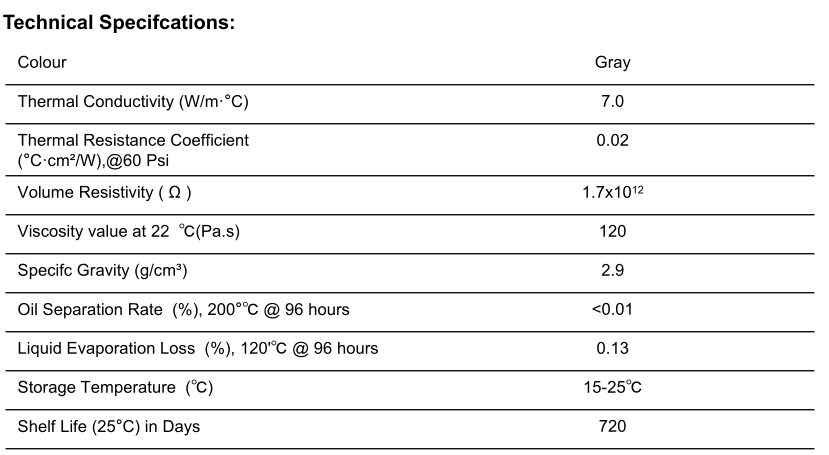
TSAS50 demonstrates a noteworthy combination of low laboratory R‑value and favorable bench performance. In D5470 testing TDAS50 measured an interface thermal resistance of0.02 °C·cm²/W(@60 Psi), and on a standardized 298 W bench it produced a temperature spread consistent with the leading products in the comparison set. This dual‑track consistency—low R‑value in the lab and low temperature on the bench—indicates an engineered balance of particle dispersion, wetting and compressibility that benefits demanding high‑power applications.
8. Selection guidance
When selecting a TIM, prioritize alignment with the application rather than a single numerical label. For designers and technicians we recommend:
- Consider measured interface resistance (R) where available, not only vendor quoted bulk conductivity.
- For thin‑gap, high‑pressure assemblies choose pastes with low BLT and good wetting.
- For large gaps or irregular surfaces prefer gel‑type TIMs designed to maintain thicker bond lines.
- For long‑life and repeatable serviceability select formulations validated for pump‑out resistance and mechanical stability.
Thermal Paste Technology: Arctic MX-4, MX-6, Thermal Grizzly, TOUSEN TSAD100
Advanced Two-Part Thermal Gel for High-Performance Thermal Management | TOUSEN
Related Article