
GPU Thermal Pads for High-Performance Computing Systems
Engineering Insight into GPU Thermal Pads: Design, Selection, and High-Performance Applications
In modern high-performance computing systems, Graphics Processing Units (GPUs) play a central role in artificial intelligence, deep learning, scientific simulation, and advanced graphics rendering. As GPU architectures continue to evolve toward higher power density and greater computational throughput, thermal management has become one of the most critical constraints affecting system stability, performance consistency, and long-term reliability.
Among various thermal interface solutions, gpu thermal pads serve as a fundamental yet often underestimated component. Acting as a thermal bridge between the GPU package and the heat dissipation structure, a properly selected gpu thermal pad can significantly reduce interface thermal resistance and improve overall heat transfer efficiency.
1. Understanding the Role of GPU Thermal Pads
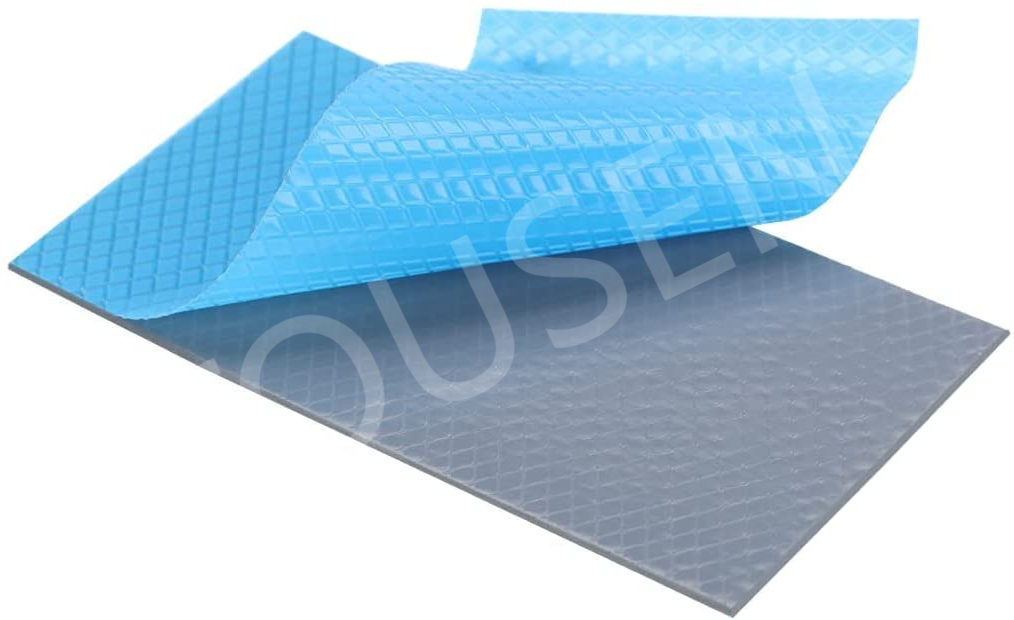
A gpu thermal pad is a compliant, thermally conductive interface material designed to fill microscopic air gaps between solid surfaces. These gaps, caused by surface roughness, tolerance stack-up, or structural variation, can dramatically degrade heat transfer if left unaddressed.
Compared with traditional thermal greases, thermal pad gpu solutions offer several practical advantages in engineering applications:
- Predefined thickness and shape for consistent thermal performance
- Clean and repeatable installation, suitable for mass production
- Stable long-term behavior without pump-out or dry-out risks
- Excellent gap-filling capability for uneven or multi-height assemblies
For these reasons, gpu thermal pads are widely adopted in GPU modules, accelerator cards, and AI server platforms where reliability and manufacturability are equally important.
2. Thermal Challenges in High-Power GPU Systems
From an engineering perspective, GPU thermal management is complicated by several factors:
- High heat flux concentrated over a relatively small die area
- Non-uniform surface flatness between GPU, memory, and heat sink
- Multiple thermal paths within confined mechanical envelopes
- Long-term thermal cycling under sustained workloads
In such conditions, the interface material becomes a decisive factor. An improperly selected thermal pad gpu may introduce excessive thermal resistance, negating the benefits of an advanced heat sink or vapor chamber design.
3. Key Performance Parameters of GPU Thermal Pads
When selecting gpu thermal pads, engineers should evaluate the following parameters holistically rather than focusing on a single data point.
3.1 Thermal Conductivity
Thermal conductivity (W/m·K) determines how efficiently heat flows through the material. High-performance GPU applications typically require gpu thermal pad materials with conductivity above 6 W/m·K, with higher values preferred for extreme power densities.
3.2 Compressibility and Conformability
A thermal pad gpu must deform sufficiently under mounting pressure to conform to surface irregularities. Excessive hardness can lead to poor contact, while overly soft materials may increase thermal resistance under load.
3.3 Thermal Impedance
Thermal impedance reflects the combined effect of conductivity, thickness, and contact resistance. Optimizing pad thickness is essential to balancing mechanical tolerance compensation and heat transfer efficiency.
3.4 Operating Temperature Range
GPU workloads often involve rapid temperature fluctuations. Reliable gpu thermal pads must maintain stable performance across a wide operating temperature range without degradation or material fatigue.
3.5 Electrical Insulation and Long-Term Stability
In many designs, the gpu thermal pad must also provide electrical insulation. Resistance to aging, oil bleed, and thermal cycling is critical for ensuring long service life in enterprise and industrial environments.
4. Material Types and Engineering Trade-Offs
Based on base polymers and filler composition, gpu thermal pads can be broadly categorized as follows:
| Material Type | Key Characteristics | Typical Applications |
|---|---|---|
| Silicone-based pads | High flexibility, excellent gap filling | Standard GPU interfaces |
| Polymer composite pads | Higher thermal conductivity | High-power GPUs |
| Phase-change materials | Lower interface resistance at operating temperature | Dynamic thermal loads |
| Metal-enhanced pads | Very high conductivity, reduced compliance | Mechanically constrained designs |
Selecting the appropriate thermal pad gpu requires balancing thermal performance, mechanical compliance, and manufacturing constraints.
5. Practical Application: GPU Modules in AI Servers
In AI server GPU modules, multiple heat sources—such as GPU cores, memory chips, and power components—often coexist on different height planes. Traditional thermal grease solutions struggle to maintain consistent performance across such complex interfaces.
By implementing high-quality gpu thermal pads, engineers can:
- Achieve uniform thermal contact across multiple components
- Improve assembly consistency in automated production lines
- Enhance long-term thermal reliability under continuous operation
Field evaluations have shown that optimized thermal pad gpu solutions can reduce GPU junction temperatures by 4–8°C compared to conventional interface materials, contributing directly to performance stability and component longevity.
6. Engineering Guidelines for Selecting GPU Thermal Pads
A structured selection process is recommended when specifying gpu thermal pads:
- Accurately measure interface gaps and tolerances
- Define thermal performance targets based on GPU TDP
- Match mechanical properties to assembly pressure
- Evaluate compatibility with automated manufacturing
- Validate performance through simulation and prototype testing
Following these steps ensures that the gpu thermal pad contributes positively to the overall thermal design rather than becoming a bottleneck.
7. High-Performance GPU Thermal Pad Solution
To address the demanding requirements of high-computing and AI applications, we have developed a series of advanced gpu thermal pads engineered specifically for high heat flux environments.
Key features include:
- Thermal conductivity exceeding 10 W/m·K
- Multiple thickness options from 0.5 mm to 5 mm
- Optimized compressibility for reliable contact
- Excellent thermal and mechanical stability over time
Detailed specifications and customization options are available at:
High Computing GPU Thermal Pad Solutions

These thermal pad gpu products have been successfully deployed in GPU accelerator cards, AI servers, and high-performance computing platforms, delivering measurable improvements in thermal efficiency.
8. Conclusion
In high-performance GPU thermal design, gpu thermal pads are no longer a secondary consideration but a core element of effective heat management. Through informed material selection, precise mechanical integration, and thorough validation, engineers can significantly enhance system performance and reliability.
A data-driven and application-oriented approach to gpu thermal pad selection ultimately enables GPUs to operate closer to their performance limits—safely, consistently, and efficiently.
Pad Thermal Solutions for CPU and Graphics Card Thermal Management
Phase Change Thermal Pad Analysis: PTM7950 vs SP250A-60
Related Article