
High Performance Thermal Pad for Reliable Heat Management
Engineering Perspective: How to Select the Right Thermal Pad for Reliable Thermal Management
As modern electronics continue to evolve toward higher performance and greater miniaturization, thermal management has become a defining factor in product reliability and lifespan. From consumer electronics and industrial control systems to EV platforms and telecom infrastructure, efficient heat dissipation is no longer optional—it is a core design requirement.
From an engineering standpoint, selecting the right thermal pad plays a critical role in ensuring stable operation. A well-matched thermal interface material can significantly reduce junction temperatures, improve system efficiency, and extend component life cycles.
Why a Thermal Pad Is Essential in Thermal Design
In most electronic assemblies, heat is transferred from heat-generating components—such as CPUs, GPUs, and power modules—to heat sinks or enclosures. However, microscopic surface irregularities create air gaps that dramatically reduce thermal conductivity.
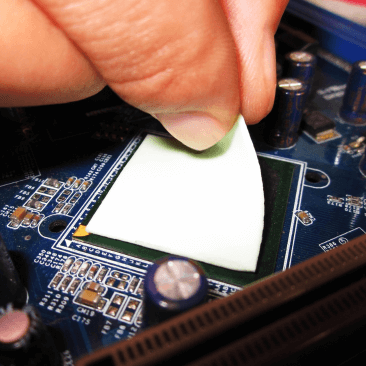
A thermal pad is designed to eliminate these gaps by conforming to uneven surfaces, thereby improving heat transfer efficiency. Compared to traditional thermal grease, a thermal pad offers several engineering advantages:
- Consistent thickness for predictable thermal performance
- Ease of installation and suitability for automated assembly
- Superior long-term stability without pump-out or dry-out
- Clean handling with minimal contamination risk
For these reasons, the thermal pad has become a preferred solution in many modern thermal management designs.
Key Parameters for Selecting a Thermal Pad
1. Thermal Conductivity
Thermal conductivity is a primary performance indicator. Typical values range from 1 W/m·K to over 10 W/m·K. For high-power applications, engineers generally specify a thermal pad with conductivity above 5 W/m·K.
2. Thickness
Available thicknesses typically range from 0.5 mm to 5 mm. The selected thermal pad must match the gap tolerance of the mechanical design. Excessive thickness can increase thermal resistance, while insufficient thickness may lead to incomplete contact.
3. Compressibility
A high compressibility (typically 30%–60%) allows the thermal pad to conform to surface irregularities, maximizing effective contact area and improving heat transfer.
4. Hardness
Lower hardness materials provide better surface conformity, while higher hardness options offer improved structural integrity. The choice depends on the mechanical constraints of the application.
5. Electrical Insulation
A reliable thermal pad should provide strong dielectric properties, typically with a volume resistivity above 1012 Ω·cm, ensuring electrical safety in dense electronic assemblies.
Application Scenarios and Placement
Consumer Electronics (Laptops, Displays)
In display modules and compact computing devices, a thermal pad is commonly used between:
- GPU and heat spreader assemblies
- Power ICs and shielding enclosures
- LED backlight modules and metal frames
Proper placement of the thermal pad helps reduce localized hotspots and ensures stable display performance.
Telecommunications Equipment
In high-power telecom systems, such as 5G base stations, a thermal pad is critical for:
- Power amplifiers (PA modules)
- FPGA and ASIC cooling interfaces
High-conductivity thermal pad solutions are essential in maintaining performance under continuous load conditions.
Electric Vehicles and Energy Systems
Within EV battery systems and power electronics, a thermal pad is used for:
- Battery pack thermal balancing
- IGBT module heat dissipation
A stable and durable thermal pad ensures consistent thermal performance over extended operating cycles.
Industrial Equipment
Industrial control systems rely on thermal pad materials for:
- Power supply modules
- Control IC heat management
Long-term reliability and resistance to aging are key considerations in these environments.
Silicone-Free Thermal Pad: A Next-Generation Solution
As environmental and reliability requirements continue to increase, traditional silicone-based materials may present challenges, such as oil bleed and contamination risks. This has led to the development of silicone-free thermal pad technologies.
A representative solution can be found here:
Silicone-Free Thermal Pads
This type of thermal pad offers several engineering benefits:
- No silicone oil migration, ideal for optical and sensitive electronics
- Stable thermal performance over long-term operation
- Good compressibility for complex geometries
- Thermal conductivity typically ≥ 3 W/m·K
From an engineering perspective, silicone-free thermal pad materials are particularly well-suited for applications requiring high cleanliness, such as display modules and imaging systems.
Best Practices for Thermal Pad Implementation
Even with the right thermal pad, proper implementation is critical to achieving optimal performance:
- Ensure all संपर्क surfaces are clean and free of contaminants
- Apply appropriate الضغط to achieve full surface contact
- Avoid over-compression that may degrade material performance
- Validate design through thermal simulation and testing
These practices help maximize the effectiveness of any thermal pad solution in real-world applications.
Conclusion
The thermal pad is a fundamental component in modern thermal management strategies. Through careful selection and proper integration, engineers can significantly improve system reliability, efficiency, and lifespan.
As performance demands continue to rise, silicone-free thermal pad solutions provide a cleaner, more stable alternative for advanced applications. For engineers seeking dependable and high-performance thermal interface materials, evaluating the right thermal pad is a critical step toward achieving optimized thermal design.
Advanced Thermal Interface Solutions for High Power Electronics
Thermal Pad Solutions for Imaging Device Thermal Management
Related Article