EV Battery Thermal Management (V): Thermal Insulation, Fire Protection & Safety Standards
Battery Pack Thermal Runaway Mitigation Series (V): Validation Methods, Testing Protocols and Global Safety Standards
In the previous parts of this series, we examined the mechanisms of thermal runaway, system-level safety architecture, material integration, and engineering implementation. However, design intent alone does not establish safety credibility. Thermal runaway mitigation must be validated through structured testing, measurable performance metrics, and compliance with international safety standards.
Building on earlier discussions in Battery Pack Safety System Management and Thermal Runaway Management, this article focuses on validation methodology, propagation testing, and global regulatory frameworks for EV and energy storage system (ESS) battery packs.
1. Engineering Philosophy: Containment Rather Than Absolute Prevention
In modern battery safety engineering, the objective is not necessarily to guarantee that thermal runaway will never occur. Most global safety standards acknowledge that single-cell failure may be possible under extreme abuse conditions.
The engineering objective therefore shifts toward:
- Controlled thermal propagation
- Delayed heat transfer between cells
- Structural containment
- Directed venting management
- Maintained electrical isolation
Validation focuses on verifying that mitigation strategies effectively control consequences rather than assuming total failure elimination.
2. Multi-Level Battery Pack Validation Framework
2.1 Cell-Level Abuse Testing
Cell-level testing establishes baseline thermal runaway behavior. Common abuse test methods include:
- Nail penetration testing
- External short circuit testing
- Overcharge testing
- Thermal abuse exposure
- Internal short simulation
These tests quantify peak temperature, combustion intensity, gas release characteristics, and total heat output. However, cell-level validation alone does not reflect module or pack-level propagation behavior.
2.2 Module-Level Propagation Testing
At the module level, evaluation centers on thermal propagation control. The primary engineering metric becomes:
Propagation Delay Time
Propagation delay time measures how long adjacent cells resist ignition after an initial cell failure event. Increasing delay time allows:
- Early detection by monitoring systems
- Activation of electrical isolation
- Intervention from cooling systems
Testing parameters include:
- Temperature gradient mapping
- Flame spread direction
- Structural deformation
- Gas accumulation behavior
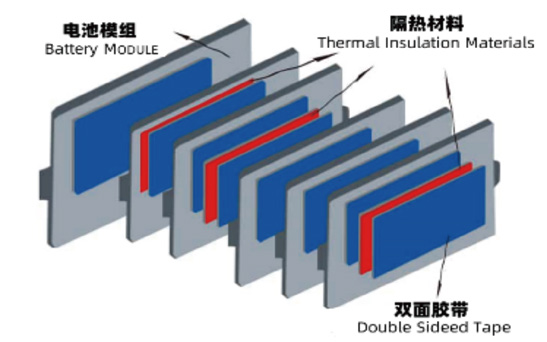
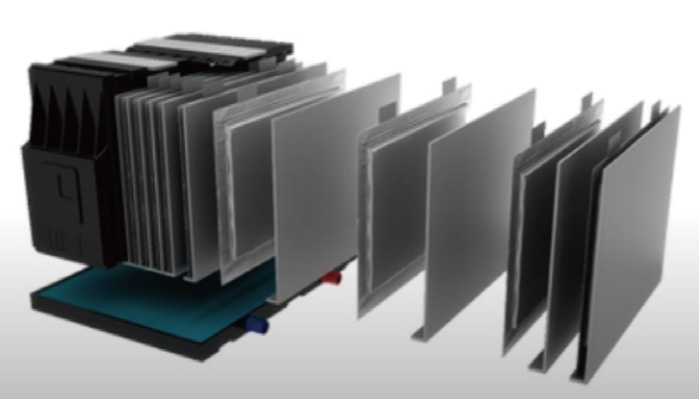
Materials such as fire-resistant barriers, thermal insulation sheets, and thermal interface materials are evaluated under extreme conditions to confirm real-world effectiveness.
2.3 Pack-Level Validation Testing
Pack-level testing represents the highest level of complexity within battery pack validation. Typical validation procedures include:
- External fire exposure testing
- Forced thermal propagation testing
- Mechanical shock and vibration testing
- Crush and impact testing
- Over-temperature simulation
- Venting and enclosure integrity evaluation
Evaluation expands beyond temperature metrics to include:
- Flame containment effectiveness
- Enclosure structural integrity
- Pressure relief control
- Post-event electrical isolation
- Smoke and gas management
3. Global Safety Standards Governing Thermal Runaway Testing
Battery pack validation is shaped by international regulatory frameworks. While testing philosophies overlap, regional standards introduce distinct compliance requirements.
3.1 UN 38.3 – Transportation Safety
UN 38.3 focuses on transportation safety, including vibration, thermal cycling, and short circuit conditions. It establishes baseline safety compliance but does not comprehensively address thermal propagation mitigation.
3.2 UNECE R100 (Europe)
UNECE R100 Rev.3 strengthens EV battery safety requirements, mandating no fire or explosion during defined propagation testing and ensuring sufficient warning time before hazardous events.
3.3 UL 2580 (North America)
UL 2580 evaluates battery systems under electrical, thermal, and fire abuse conditions. Emphasis is placed on containment and post-failure safety behavior.
3.4 IEC 62619 (Industrial & ESS Applications)
IEC 62619 applies to stationary and industrial lithium battery systems, addressing abuse testing relevant to energy storage installations. Thermal runaway mitigation plays a critical role in ESS certification.
3.5 GB 38031 (Thermal Propagation Focus)
GB 38031 introduces explicit propagation delay requirements, demonstrating regulatory recognition that measurable mitigation performance must be validated.
4. Propagation Delay Time as a Quantitative Design Parameter
Propagation delay is influenced by:
- Inter-cell spacing
- Barrier thickness and material properties
- Thermal conductivity distribution
- Structural confinement geometry
- Heat dissipation pathways
Increasing delay time must be balanced against normal operating thermal efficiency. Excess insulation may negatively impact cooling performance. Therefore, simulation and empirical validation must be combined.
For broader EV thermal architecture context, see: EV Battery Thermal Management.
5. Material Performance Under Extreme Abuse Conditions
During validation testing, materials are exposed to flame, rapid temperature rise, and combustion gases. Evaluation criteria include:
- Flame spread resistance
- Intumescent expansion behavior
- High-temperature thermal stability
- Structural integrity retention
- Gas release characteristics
Thermal conductivity values measured under steady-state laboratory conditions do not fully represent behavior during thermal runaway events. Abuse-condition testing is essential.
6. Integration of Active and Passive Mitigation Systems
Battery packs combine passive safety materials with active systems such as:
- Battery Management Systems (BMS)
- Temperature monitoring networks
- Cooling systems
- Electrical disconnect mechanisms
Validation testing verifies interaction timing:
- Detection before propagation
- Isolation before enclosure failure
- Controlled venting direction
System maturity is defined by coordinated response.
7. Testing Limitations and Real-World Considerations
Laboratory validation provides repeatability. However, real-world battery packs experience:
- Aging and degradation
- Manufacturing tolerances
- Mechanical fatigue
- Environmental variation
Advanced validation programs therefore incorporate aging simulation and durability preconditioning to ensure long-term mitigation reliability.
Conclusion: Validation as the Foundation of Thermal Runaway Mitigation
Thermal runaway mitigation cannot rely solely on theoretical modeling or material datasheets. It must be validated through structured testing, quantifiable propagation control metrics, and compliance with global standards.
From cell-level abuse testing to full pack-level fire exposure, validation confirms whether mitigation strategies remain effective under extreme conditions.
Engineering integrity is defined not by the assumption that failure will never occur, but by the ability to control its impact when it does.
Battery Pack Thermal Runaway Mitigation (VI): Risk Modeling and Predictive Thermal Engineering
Battery Pack Thermal Runaway Mitigation Series (四) – Engineering Implementation
Related Article