When to Replace Thermal Paste for Reliable Thermal Management
When Should You Replace Thermal Paste A Practical Guide for Engineers
In electronic thermal management, thermal paste is often treated as a small but important material between a heat-generating component and a heat sink. Although the amount used in each application may be limited, its influence on thermal performance can be significant. From CPUs and GPUs to power modules, industrial controllers and communication equipment, the condition of the interface material directly affects heat transfer efficiency and long-term operating stability.
One common question from engineers is: when should thermal paste be replaced? There is no universal replacement interval that applies to every device. The appropriate maintenance cycle depends on operating temperature, thermal load, material stability, assembly conditions and the specific formulation of the thermal interface material.
Why Does Thermal Paste Need to Be Replaced?
The primary function of thermal paste is to fill microscopic air gaps between two mating surfaces. Even apparently flat metal surfaces contain microscopic irregularities. Air has relatively poor thermal conductivity, so eliminating these air gaps helps establish a more efficient thermal path from the heat source to the heat sink.
During long-term operation, however, thermal interface materials can experience physical and chemical changes. Repeated heating and cooling may cause changes in viscosity, migration, drying or other forms of material degradation, depending on the formulation.
For this reason, engineers should not determine the replacement cycle of thermal grease simply according to elapsed time. Instead, the thermal behavior of the actual equipment should be considered together with the material's specifications.
Five Situations Where Thermal Paste Replacement Should Be Considered
1. Operating Temperature Gradually Increases
A gradual increase in CPU, GPU, power semiconductor or other component temperature is one of the most useful practical indicators.
If the workload, ambient temperature, cooling fan and system configuration remain substantially unchanged, but the component temperature continues to rise, engineers should inspect the entire thermal path. Deteriorated thermal paste may be one possible cause, although dust accumulation, fan degradation, heat sink blockage and changes in system power consumption should also be investigated before replacing the material.
This diagnostic approach is important because high temperature does not automatically mean that the thermal interface material has failed.
2. The Thermal Interface Has Become Dry or Uneven
During equipment maintenance, visual inspection can provide useful information. If the original thermal grease has become excessively dry, separated, hardened or unevenly distributed, its ability to maintain intimate contact between the heat source and heat sink may have been reduced.
However, visual appearance alone should not be used as the only acceptance criterion. Different formulations have different physical characteristics, and some high-performance materials may retain their thermal performance even when their appearance changes slightly.
3. The Heat Sink Has Been Removed
From an engineering perspective, replacing thermal paste is generally recommended whenever a conventional paste-based thermal interface is disturbed by removing the heat sink.
After separation, the original material may no longer provide a uniform interface. Reusing contaminated or unevenly distributed thermal grease can introduce additional air gaps and increase thermal resistance.
For CPUs, GPUs and power electronics, cleaning the mating surfaces and applying a controlled amount of fresh material is normally more reliable than attempting to reuse the old interface layer.
4. The Equipment Operates Under High Thermal Stress
Equipment operating continuously at elevated temperatures or under substantial thermal cycling requires closer attention to thermal interface stability. Examples include servers, industrial power supplies, inverter systems, telecommunications equipment, automotive electronics and high-performance computing platforms.
In these applications, the replacement strategy should be based on actual reliability requirements rather than a simple consumer-oriented maintenance schedule. Engineers should review the material's temperature range, aging characteristics, pump-out resistance and compatibility with the assembly structure.
5. Thermal Performance Testing Shows Abnormal Results
For professional applications, the most reliable method is measurement. Temperature sensors, thermal imaging, controlled load testing and comparative testing can help determine whether the thermal interface is contributing to a performance problem.
If replacing the thermal paste produces a measurable and repeatable reduction in component temperature under equivalent conditions, the previous interface may have contributed to the thermal limitation.
Thermal Paste vs Thermal Grease vs Thermal Gels
Different thermal interface materials should not be considered interchangeable simply because they are all used for heat transfer.
Thermal paste and thermal grease are commonly used where a thin, conformal interface layer is required between relatively flat surfaces. Their performance depends not only on nominal thermal conductivity, but also on viscosity, wetting behavior, bond-line thickness, stability and application process.
Thermal gels, by comparison, are often selected when larger gaps, uneven surfaces or mechanical tolerance require a softer and more compliant material. Depending on the formulation, thermal gels can provide advantages in applications where traditional thermal grease is difficult to maintain as a stable interface.
Therefore, choosing between thermal paste, thermal grease and thermal gels should be based on the actual interface geometry, compression conditions, thermal load and reliability requirements.
What Engineers Should Consider When Selecting Thermal Paste
Thermal conductivity is an important parameter, but it should never be evaluated in isolation. A material with a high nominal thermal conductivity may not deliver the expected system-level performance if it cannot form an appropriate bond line or maintain stable contact during long-term operation.
Engineers should evaluate several parameters together, including:
- Thermal conductivity
- Thermal resistance
- Viscosity and application characteristics
- Operating temperature range
- Long-term aging stability
- Pump-out and dry-out resistance
- Material compatibility
- Electrical properties where required
- Application thickness and process control
For automated production, dispensing consistency can be particularly important. For maintenance applications, ease of application and surface compatibility may receive greater priority.
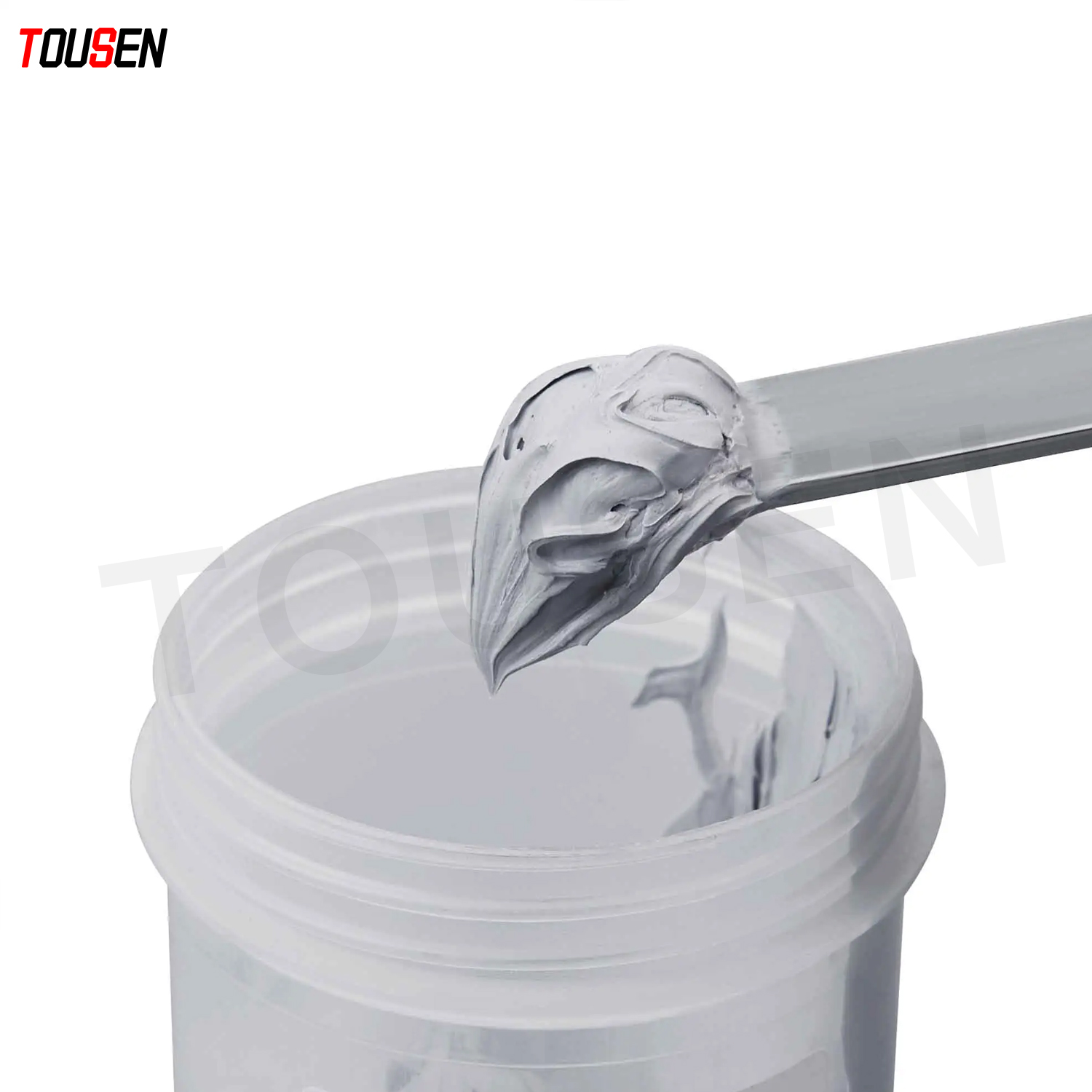
TSAS50 Thermal Paste for Thermal Management Applications
For applications requiring a reliable thermal interface material, TOUSEN provides TSAS50 Thermal Paste as one option for thermal management design and application.
TSAS50 is designed for thermal interface applications where efficient heat transfer and consistent interface contact are required. When evaluating a thermal paste, engineers should consider not only the material's reported thermal conductivity but also how it performs under the actual assembly conditions.
For example, the required amount of thermal grease should be controlled according to the interface geometry. Applying more material does not necessarily improve cooling performance. Excessive thickness can increase the effective thermal path, while insufficient material may leave microscopic air gaps.
For this reason, process control is just as important as material selection. A suitable dispensing method, controlled bond-line thickness and consistent surface preparation can significantly improve repeatability across production batches.
How Often Should Thermal Paste Be Replaced?
There is no technically responsible answer such as “every six months” or “every two years” that can be universally applied to all equipment.
For consumer electronics operating under moderate conditions, replacement may only become necessary when thermal performance deteriorates or the heat sink is removed. For servers, industrial equipment and high-power electronics, preventive maintenance can be incorporated into a broader reliability program based on operating temperature, workload, environmental conditions and historical test data.
The better engineering principle is therefore condition-based replacement rather than time-based replacement.
If temperature remains stable, the cooling system operates normally and the interface material remains within its specified operating conditions, unnecessary replacement may provide little benefit. Conversely, abnormal temperature increases, material degradation, mechanical disturbance or maintenance of the heat sink are strong reasons to inspect and potentially replace the thermal paste.
Conclusion
Replacing thermal paste should be regarded as part of thermal management and equipment reliability rather than simply a routine maintenance task. Engineers should evaluate temperature trends, thermal load, interface condition, assembly changes and material specifications before making a replacement decision.
At the same time, thermal paste, thermal grease and thermal gels each have their appropriate application scenarios. Selecting the correct material requires a system-level evaluation rather than focusing on a single parameter such as thermal conductivity.
For applications requiring a dependable thermal interface, TOUSEN TSAS50 Thermal Paste can be considered as part of the thermal management solution. By combining appropriate material selection with controlled application processes and condition-based maintenance, engineers can achieve more stable and predictable thermal performance over the service life of electronic equipment.
How to Use Thermal Paste Correctly for Better Heat Transfer
How to Choose Thermal Paste for AI Server Cooling Systems
Related Article