How to Choose Thermal Paste for AI Server Cooling Systems
How to Choose Thermal Paste for AI Hardware: An Engineering Guide to Thermal Management
As artificial intelligence, high-performance computing (HPC), and data center infrastructure continue to evolve, the thermal demands placed on modern processors are increasing rapidly. AI accelerators, GPUs, CPUs, and high-power electronic components are generating higher heat fluxes while operating under sustained workloads. As a result, conventional cooling methods alone are often no longer sufficient to maintain stable operating temperatures.
In this environment, thermal paste, thermal grease, and thermal gels have become increasingly important thermal interface materials (TIMs). Among these solutions, thermal paste remains widely used in CPUs, GPUs, AI servers, power electronics, and other high-performance systems because it can fill microscopic surface imperfections and create a more efficient thermal path between a heat-generating component and its heat sink.
However, selecting the right thermal interface material for AI hardware is not simply a matter of choosing the product with the highest thermal conductivity. From an engineering perspective, material selection should consider the complete thermal and mechanical system, including interface resistance, bond-line thickness, rheological behavior, mounting pressure, long-term reliability, manufacturing processes, and operating conditions.
Why AI Hardware Is Increasingly Dependent on High-Performance Thermal Paste
AI computing systems differ from many conventional electronic devices because their processors may operate at high utilization for extended periods. GPUs and AI accelerators can generate substantial amounts of heat within a relatively small package area, resulting in significantly higher local heat flux.
Even precision-machined semiconductor packages and heat sinks are not perfectly flat at the microscopic level. Small surface irregularities create air gaps between the two surfaces. Because air has relatively poor thermal conductivity compared with dedicated thermal interface materials, these gaps can substantially increase thermal resistance.
The primary function of thermal paste is to fill these microscopic voids and improve contact between the semiconductor package and heat sink. By replacing trapped air with a thermally conductive material, thermal paste helps establish a more continuous heat-transfer path.
For this reason, engineers should evaluate thermal interface materials based on their actual application performance rather than relying on a single specification. Thermal conductivity, viscosity, wetting behavior, rheology, pump-out resistance, volatility, thermal stability, and long-term consistency can all influence the final thermal performance of a system.
Thermal Paste vs Thermal Grease: What Engineers Should Consider
In the thermal management industry, the terms thermal paste and thermal grease are often used interchangeably to describe paste-like thermal interface materials. In practice, the product name is less important than the material's measured properties and its compatibility with the intended application.
For AI servers and high-performance computing platforms, engineers need to consider the relationship between material viscosity, application method, interface thickness, mounting pressure, and component geometry.
For example, a thermal grease with excessive viscosity may create challenges for automated dispensing or precision application. On the other hand, a material with excessively low viscosity may have difficulty maintaining the desired position and thickness during assembly or long-term operation.
Long-term mechanical stability is another important consideration. During repeated heating and cooling cycles, differences in the thermal expansion of the semiconductor package and heat sink can generate mechanical stress within the interface material. Over time, this may contribute to pump-out or other forms of interface degradation.
Therefore, selecting a thermal grease for AI hardware requires more than comparing datasheet numbers. The material must be evaluated together with the mechanical structure, mounting conditions, dispensing process, and expected thermal cycling profile.
Where Thermal Gels Fit in Modern Thermal Management
Thermal gels represent another category of thermal interface materials designed for applications where compliance, gap accommodation, and structural tolerance are important.
Compared with conventional thermal paste, thermal gels can offer a softer and more conformable interface. This makes them useful in certain electronic assemblies where component height variation, larger gaps, or complex surface geometry make conventional paste-based interfaces less practical.
However, thermal gels should not automatically be considered a replacement for thermal paste or thermal grease. Each material category addresses different engineering requirements.
For a processor mounted directly to a heat sink with a controlled interface thickness and sufficient mounting pressure, a properly selected thermal paste may provide an efficient and practical solution. In contrast, applications with larger gaps or greater mechanical tolerance may benefit from thermal gels.
The engineering objective is therefore not to determine which material is universally superior, but to identify which TIM provides the best combination of thermal performance, process compatibility, mechanical stability, and long-term reliability for the specific system.
Four Key Factors When Selecting Thermal Paste for AI Servers
1. Do Not Evaluate Thermal Conductivity Alone
Thermal conductivity is one of the most commonly referenced specifications for a thermal paste, but it should not be treated as the only indicator of real-world thermal performance.
The actual thermal path is affected by the material's bond-line thickness, surface wetting, interface contact, application uniformity, and mounting pressure. A material with a high nominal thermal conductivity may not deliver the expected system-level performance if it cannot form a stable and sufficiently thin interface layer.
For AI processors and high-power GPUs, engineers should therefore evaluate both the intrinsic thermal properties of the material and its effective interface performance under realistic assembly conditions.
2. Match Viscosity and Rheology to the Manufacturing Process
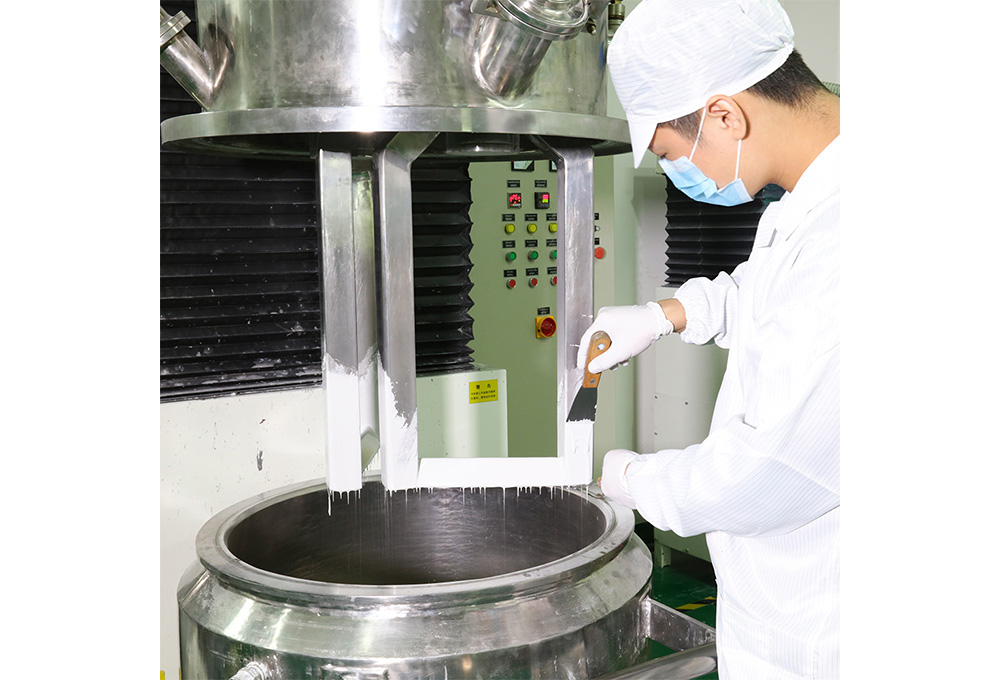
Modern AI servers and electronic systems are increasingly manufactured using automated assembly processes. As a result, the processing characteristics of thermal interface materials have become just as important as their thermal properties.
Engineers should consider dispensing equipment, dispensing speed, application pattern, target bond-line thickness, and production throughput when selecting thermal grease or thermal paste.
Consistent rheological behavior is particularly important for high-volume manufacturing because variations in deposited material can lead to differences in interface thickness and ultimately affect thermal performance from unit to unit.
3. Prioritize Long-Term Reliability
AI servers are often designed for continuous operation, making long-term thermal stability critical. A thermal paste that performs well during initial testing may not necessarily maintain the same performance after extended exposure to elevated temperatures and repeated thermal cycling.
Engineering validation should therefore consider potential pump-out, dry-out, oil separation, volatility, thermal degradation, and changes in thermal resistance over time.
These effects may not be obvious during short-duration testing, but they can become significant during long-term operation. For this reason, reliability testing under representative temperature and mechanical conditions should be part of the material qualification process.
4. Consider Electrical and Material Compatibility
Depending on the system architecture, a thermal interface material may be located close to electrical contacts, components, or sensitive package structures. Engineers should therefore verify the required electrical properties and material compatibility before qualification.
Compatibility with semiconductor packages, heat sink surfaces, protective coatings, adhesives, and neighboring materials should also be considered, particularly in densely packaged AI and power electronics systems.
How Engineers Should Select Thermal Paste for AI Chips
A practical thermal interface material selection process can be divided into three stages.
First, define the thermal load. Determine the actual power consumption and heat flux of the CPU, GPU, or AI accelerator under the intended operating conditions. The chip model alone is not sufficient to determine the appropriate TIM.
Second, analyze the interface structure. Consider package dimensions, heat sink flatness, target bond-line thickness, mounting pressure, surface conditions, and assembly tolerances.
Third, evaluate material and process compatibility. The selected thermal paste should be tested using the actual dispensing equipment, application method, assembly pressure, and thermal cycling conditions expected in production.
For applications requiring a balance of thermal performance, processing characteristics, and long-term stability, TOUSEN TSAS50 Thermal Paste can be considered as one candidate for engineering evaluation. More product information is available on the official product page:
For a specific AI or high-performance computing application, the final material selection should be based on the actual processor power, interface thickness, heat sink design, dispensing method, operating temperature, and reliability requirements. Laboratory validation under representative conditions is recommended before mass production.
AI Is Changing the Way Thermal Interface Materials Are Selected
The rapid development of AI computing is changing the traditional approach to thermal management. In the past, engineers often focused heavily on the thermal conductivity rating of a thermal paste. For today's high-power processors, however, a single material parameter cannot accurately represent overall system performance.
Modern TIM selection is increasingly focused on system-level compatibility. The interaction between the thermal paste, semiconductor package, heat sink, mechanical assembly, and manufacturing process can be just as important as the material's nominal thermal conductivity.
For high-power GPUs, engineers may prioritize low interface resistance and resistance to pump-out. For large-scale server production, dispensing consistency and process stability can become major selection criteria. For electronic assemblies with larger structural gaps, thermal gels may provide better compliance and gap-filling capability.
This means that thermal paste, thermal grease, and thermal gels should not be viewed simply as competing products. They are different engineering solutions that can be selected according to the thermal, mechanical, and manufacturing requirements of the application.
Conclusion
The continued growth of AI, high-performance computing, and data center infrastructure is placing unprecedented thermal demands on modern electronic systems. As a critical interface between heat-generating components and heat sinks, thermal paste remains an important part of the thermal management architecture for CPUs, GPUs, AI accelerators, and other high-power devices.
From an engineering perspective, choosing the right thermal paste or thermal grease should not be based solely on the highest thermal conductivity specification. Engineers should evaluate interface resistance, bond-line thickness, rheological behavior, application process, mechanical stability, operating temperature, material compatibility, and long-term reliability as part of a complete system-level assessment.
At the same time, thermal gels can provide advantages in applications where compliance and gap accommodation are more important. Rather than relying on a single TIM category, future thermal management strategies will increasingly use application-specific material selection based on actual operating conditions.
For companies developing AI servers, GPUs, CPUs, HPC platforms, and high-power electronic systems, establishing a practical TIM qualification process based on real operating conditions is more valuable than comparing isolated material specifications. The right thermal interface material is ultimately the one that delivers consistent thermal performance while remaining compatible with the mechanical structure, manufacturing process, and long-term reliability requirements of the system.
When to Replace Thermal Paste for Reliable Thermal Management
Thermal Paste for AI Rail Transit and Railway Electronics
Related Article