Thermal Paste for AI Automotive Electronics Thermal Management

Thermal Paste in Automotive Electronics in the Age of AI
Artificial intelligence is rapidly becoming part of modern automotive systems. Advanced driver assistance systems, intelligent cockpits, autonomous driving platforms, vehicle communication systems and centralized computing architectures are all increasing the amount of computing power installed in vehicles. As semiconductor performance rises, thermal management is becoming an increasingly important engineering consideration.
From an engineering perspective, the challenge is not simply how to add a larger heatsink or increase airflow. Automotive electronic components often operate in compact spaces, under vibration, temperature cycling and demanding reliability requirements. The thermal interface material between a heat-generating component and its cooling structure therefore plays an important role. In many applications, thermal paste and thermal grease remain practical solutions for reducing thermal contact resistance, while thermal gels provide an alternative when compliance and gap compensation are more important.
Why AI Is Increasing Thermal Requirements in Automotive Electronics
AI-enabled automotive functions require significantly more computing resources than many traditional vehicle control systems. AI processors, GPUs, NPUs, high-performance SoCs and power electronics can generate substantial amounts of heat during continuous operation.
The issue becomes more complicated when these components are installed in compact electronic control units. Limited installation space can restrict the size of the cooling structure, while sealed enclosures can make natural heat dissipation less effective. Under these conditions, engineers need to establish a low-resistance thermal path from the semiconductor package to the heatsink or chassis.
This is one of the areas where thermal paste and thermal grease can provide value. Even apparently smooth metal surfaces contain microscopic irregularities. When two surfaces are directly assembled, air can remain inside these microscopic gaps. Because air has relatively poor thermal conductivity, these gaps can increase thermal resistance.
A properly selected thermal paste fills these surface irregularities and improves physical contact between the heat source and cooling interface. However, thermal conductivity alone should not determine material selection. Engineers must also consider viscosity, wetting behavior, pump-out resistance, operating temperature, aging characteristics, electrical properties and compatibility with surrounding materials.
Thermal Paste and Thermal Grease Are Not Exactly the Same Engineering Choice
In practical discussions, thermal paste and thermal grease are sometimes used interchangeably. In engineering applications, however, the terminology can describe different material formulations and application requirements depending on the manufacturer and industry.
Both materials are generally designed to improve heat transfer across a thermal interface. Their performance depends not only on the nominal thermal conductivity of the material but also on the actual bond-line thickness, surface condition, assembly pressure and long-term stability.
For automotive electronics, a material with extremely high thermal conductivity is not automatically the best choice. For example, if a material is difficult to dispense, spreads inconsistently or experiences excessive migration during thermal cycling, its real-world thermal performance may be less stable than laboratory data suggests.
Therefore, engineers should evaluate thermal paste and thermal grease based on the complete application rather than a single specification. Process compatibility is particularly important in automotive production, where automated dispensing, repeatable coating thickness and production cycle time can directly affect manufacturing efficiency.
Where Thermal Paste Can Be Used in AI-Enabled Vehicles
As vehicle electronics become more centralized, the application range for thermal paste continues to expand. Typical thermal management scenarios include AI computing units, ADAS controllers, automotive GPUs, high-performance SoCs, communication modules and selected power electronic components.
AI computing modules are particularly sensitive to temperature because semiconductor performance, power consumption and reliability are closely related to operating temperature. Effective heat transfer can help maintain a more stable thermal environment and reduce the risk of thermal throttling during sustained workloads.
Power electronics represent another important application area. Components such as MOSFETs, IGBTs and other power semiconductor devices generate heat during switching and power conversion. Depending on the package design and mechanical structure, thermal grease or a specialized thermal paste can be applied between the device package and cooling structure to establish an efficient thermal path.
When Thermal Gels May Be More Appropriate
Not every automotive electronic assembly is ideally suited to thermal paste or thermal grease. When there are relatively large or variable gaps between components and a heatsink, a compliant thermal material may provide better mechanical accommodation.
This is where thermal gels can become an alternative. Compared with conventional paste-like materials, thermal gels can be designed to accommodate surface variations and component height tolerances while maintaining a relatively soft interface.
From an engineering perspective, the choice between thermal paste, thermal grease and thermal gels should be based on the interface geometry, required thermal resistance, mechanical stress, assembly process and long-term reliability requirements.
For a thin and relatively uniform interface, thermal paste can be an efficient solution. For applications requiring specific dispensing or interface characteristics, thermal grease may be appropriate. Where compliance and gap compensation are critical, thermal gels may offer a more suitable approach.
TSAS50 Thermal Paste for Automotive Thermal Management
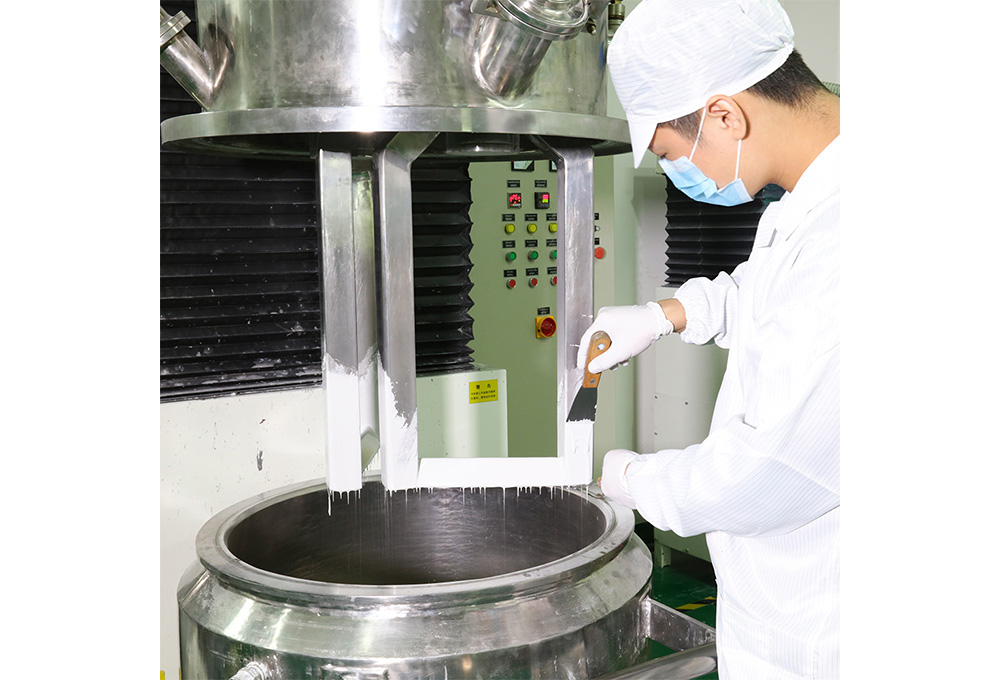
For automotive electronics manufacturers and thermal engineers looking for a practical thermal interface solution, TOUSEN provides TSAS50 thermal paste for thermal management applications.
TSAS50 is designed for applications where an efficient thermal interface is required between heat-generating electronic components and cooling structures. In engineering evaluation, the material should be considered together with the actual component package, contact surface, dispensing method, bond-line thickness and operating environment.
Rather than selecting a thermal paste only according to its advertised thermal conductivity, engineers should conduct application-level testing. Key evaluation factors can include thermal resistance, viscosity, dispensing consistency, surface wetting, operating temperature range, aging stability and compatibility with the surrounding assembly.
For automotive applications, this evaluation process is particularly important because electronic systems can experience repeated temperature changes, vibration and long operating cycles. A reliable thermal grease or thermal paste solution must therefore perform consistently throughout the expected service life of the application.
How Engineers Should Select a Thermal Interface Material
A practical selection process should begin with the thermal architecture rather than the material catalogue. First, determine the heat generation of the target component and the available cooling path. Next, evaluate the interface dimensions, allowable bond-line thickness and mechanical assembly conditions.
The second step is to compare candidate materials. Thermal paste, thermal grease and thermal gels should be evaluated under comparable test conditions. Thermal conductivity is useful for initial screening, but thermal resistance under actual assembly conditions is often more meaningful.
The final step is reliability validation. Automotive electronics require more than initial thermal performance. Engineers should consider thermal cycling, vibration, material migration, aging and compatibility with plastics, metals, coatings and semiconductor packages.
The Future of Thermal Management for AI Automotive Electronics
AI will continue to increase the computing capability of vehicles, and this trend will inevitably place greater demands on thermal management. Higher processor performance, greater power density and increasingly compact electronic architectures will make the thermal interface an important part of system-level design.
In this environment, thermal paste and thermal grease will continue to serve applications where low interface resistance and efficient heat transfer are required, while thermal gels will remain valuable for applications involving compliance and gap compensation.
The key engineering principle is straightforward: there is no universally optimal thermal interface material. The correct solution depends on the heat source, interface structure, manufacturing process and reliability requirements. By evaluating thermal performance together with mechanical and process characteristics, automotive manufacturers can build more reliable thermal management systems for the next generation of AI-enabled vehicles.
For engineers evaluating thermal interface materials for automotive electronics, TOUSEN TSAS50 thermal paste can be considered as one candidate for application-specific testing and validation.
Thermal Paste for AI Rail Transit and Railway Electronics
Thermal Paste for AI Servers CPUs GPUs and Thermal Management
Related Article