
High-Performance Thermal Materials for Mining Rigs | TOUSEN
Thermal Materials in Mining-Rig Cooling: Engineering Assessment and Material Guidance
Abstract — Mining rigs impose extreme, continuous thermal loads on devices and system structures. This technical note evaluates the engineering role of thermal interface materials (TIMs) — including thermal grease, thermal pads, phase-change pads, metal-based pads and indium solutions — within air-cooled, liquid-cooled and immersion cooling architectures. TOUSEN material examples (TSAD100 thermal paste and SF800 pad families) are integrated as engineering references. The objective is to provide unbiased guidance for material selection, verification, and production assembly for 7×24 mining operations.
1. Why TIMs matter in modern mining rigs
Mining rigs (ASIC/GPU based) have shifted from modest, intermittent loads to sustained, high power density operation. Modern racks can present kW-level heat densities per chassis and elevated local heat fluxes at device hotspots. In that context the thermal chain — die → package → TIM → heatsink/coldplate → coolant — is frequently limited by the TIM layer. Small changes in interface thermal resistance (Rth) directly translate to substantial ASIC junction temperature changes and therefore reliability and performance impacts.
Key engineering parameters for TIM selection: intrinsic thermal conductivity (W/m·K), contact thermal resistance (m²·K/W), bond line thickness (BLT) control, mechanical compliance (creep/recovery), compatibility with cooling media (oil/fluorinated fluids), and long-term stability under thermal cycling and vibration.
2. TIM types and their engineering roles
2.1 Thermal greases (thermal pastes)
Thermal greases deliver the lowest achievable contact thermal resistance when BLT and contact pressure are well controlled. They are therefore the primary choice for die→coldplate interfaces in designs where minimal interface resistance is the target.
Engineering trade-offs: grease performance depends on viscosity, filler loading and particle morphology. Long-term concerns for mining rigs are pump-out under thermal cycling and vibration, volatile loss at elevated temperatures, and potential migration onto surrounding circuitry. Modern industrial greases reduce these failure modes through low oil-separation chemistries and higher filler content.
TOUSEN reference — TSAD100: TSAD100 is an engineered thermal paste that combines elevated thermal conductivity (6.5 W/m·K class) with low oil-separation and extended shelf life. For high-power ASIC interfaces where BLT is small and assembly can control pressure, TSAD100 is a material option to minimize interface Rth. For details see the product page: TSAD100 Thermal Grease — TOUSEN.
2.2 Thermal pads and gap fillers
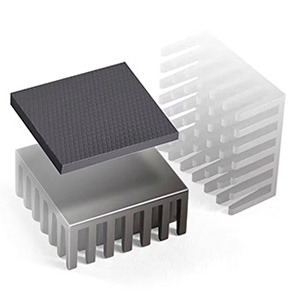
Gap pads (silicone/composite pads) are the pragmatic solution for board-level power components (VRMs, MOSFETs, inductors) where device heights vary and assembly needs high throughput. Pads are available in different hardness ratings and conductivities. Their advantages are rapid assembly and low rework cost; their challenges are higher intrinsic contact resistance than a well-applied grease and potential long-term compression set.
TOUSEN reference — SF800 and pad factory: TOUSEN’s thermal pad factory supports a range of silicone pad formulations. The SF800 family is an engineering example of a high-compliance thermal pad optimized for compression and recovery behavior in dense power assemblies. TOUSEN’s pad services also include cutting, adhesive backings and custom thickness tolerance control: Thermal Pad Factory — TOUSEN.
2.3 Phase-change materials (PCMs) and phase-change pads
Phase-change materials are solid at room temperature and soften at an engineered transition temperature to wet micro-asperities and reduce interface thermal resistance. PCMs improve assembly handling while delivering grease-like interface conductance after the first thermal ramp. They remove pump-out concerns and can be advantageous where automated application of grease is difficult.
2.4 Metal-based TIMs and indium solutions
Soft metal TIMs (indium foils, low-melting alloys, and metal phase-change pads) offer the lowest thermal resistance and excellent long-term stability. Indium provides high conformability and very low interface resistance, making it a candidate for extreme heat flux hotspots. The trade-offs are cost, susceptibility to cold-welding/deformation if assembly torque is uncontrolled, and surface preparation requirements.
3. Cooling architecture considerations (air vs. liquid vs. immersion)
Material selection must be paired to the chosen cooling architecture:
- Air cooling: mechanical simplicity favors thermal grease for die interfaces (where BLT control exists) and gap pads for board-level components.
- Direct liquid coldplates: coldplates demand materials with minimal interface Rth. TSAD100-class greases or metal phase-change pads are typical; coldplate surface flatness and bolt preload become critical.
- Immersion cooling: immersion oil or dielectric fluids impose chemical compatibility constraints. Silicone pads and conventional greases can absorb fluid or degrade; metal-based TIMs or engineered oil-compatible pads typically perform better.
Designers should treat TIM selection as a system variable: surface finish, clamp pressure, BLT specification, and expected vibration spectrum are all design inputs.
4. Mine-grade failure modes and verification tests
Mining rig environments drive accelerated failure modes that do not appear in consumer electronics testing. Key failures include pump-out under continuous vibration, thermal cycling induced delamination or cracking in PCMs, and compression-set in gap pads leading to loss of contact pressure.
Recommended verification test matrix (minimum):
- Steady-state thermal resistance mapping at representative clamp pressures (measure Rth vs BLT).
- Thermal cycling (−40°C to +125°C, 500–1000 cycles) with Rth tracking.
- High-temperature storage plus evaporation/oil-separation tests at 120–200°C depending on use case.
- Vibration testing while under thermal load to assess pump-out and material migration.
- Compatibility testing with immersion fluids where applicable (mineral oil, fluorinated dielectric fluids).
TOUSEN materials such as TSAD100 are developed with low oil-separation and low evaporation loss in mind; nonetheless, system-level validation remains mandatory.
5. Practical selection and assembly guidance
For a systematic selection process, engineers should:
- Quantify allowable interface thermal resistance for each hotspot from thermal simulation (junction temperature targets, Tj,max).
- Select a TIM candidate class (grease / PCM / pad / metal) based on allowable Rth, gap tolerance, and serviceability requirements.
- Define assembly practices: BLT targets, torque specifications, and cleanliness procedures. For metal TIMs and indium, use controlled torque sequences and flatness tolerances (typically <0.05 mm for critical surfaces).
- Execute a verification campaign (see test matrix). Only release to volume production after Rth stability is demonstrated across accelerated stress tests.
- Define maintenance/replace intervals and in-field repair procedures (pads are generally simpler to replace than re-applying grease in a dense rack environment).
Example combinations used in practice:
| Location | Recommended TIM class | Notes |
|---|---|---|
| ASIC die → coldplate (direct liquid) | High-conductivity grease (TSAD100) or metal PCM | Control BLT; use torque fixtures; perform Rth mapping |
| VRM / MOSFET → chassis | High-compliance thermal pad (SF800 style) | Design for compression set and adhesive retention |
| Immersion environments | Metal pads / oil-compatible PCM | Validate oil compatibility and swelling |
6. Material examples and short notes (engineering perspective)
TSAD100 (Thermal Grease) — engineered for low oil separation and stable evaporation characteristics. Recommended where BLT control is available and where a low interface Rth is a strict requirement. See product page: TSAD100.
SF800 style thermal pads — representative of a class of high-compliance silicone pads intended for board-level power components. Effective for automated assembly and where mechanical tolerance compensation is required. Refer to TOUSEN’s pad factory for custom thickness and hardness options: Thermal Pad Factory (SF800 example).
Phase-change metal pads — provide grease-like contact after thermal activation while remaining solid for handling. Use where a grease-level Rth is needed but grease pump-out is a concern.
Indium foils / indium-alloy pads — deliver the lowest interface thermal resistance and excellent long-term stability. Appropriate for highest heat flux hotspots; cost and careful surface preparation are the limiting factors.
Graphite/graphene sheets — excel at lateral heat spreading; combine well with other TIMs to homogenize hotspot distribution to the coldplate or heatsink.


7. Conclusion — engineering outlook for mining-rig TIMs
In 7×24 mining operations, TIM selection is no longer a commodity decision; it is an engineering driver for performance and reliability. The trend is clear: where BLT and assembly controls allow, teams will migrate to lower Rth solutions (metal PCM, indium) for core hotspots while using high-compliance pads for board-level power parts. Robust verification — including oil compatibility for immersion, thermal cycling, vibration and compression-set testing — must be part of the bill of materials acceptance process.
TOUSEN materials such as TSAD100 and the SF800-style pad family are purpose-designed to address the distinct failure modes encountered in mining rigs: pump-out, compression set, and fluid compatibility. However, materials alone do not guarantee success — precise mechanical specification and a rigorous validation plan are required to realize the theoretical thermal benefits in production and in the field.
Thermal Interface Materials in 5G/6G | TOUSEN SF & BN Pads
Thermal Silicone Pad Solutions for Reliable EV Charger Heat Management
Related Article